Artificial Intelligence (AI) is everywhere—in products, workflows, decision-making, and even creativity. Yet for many leaders and teams, AI still feels confusing and fragmented.
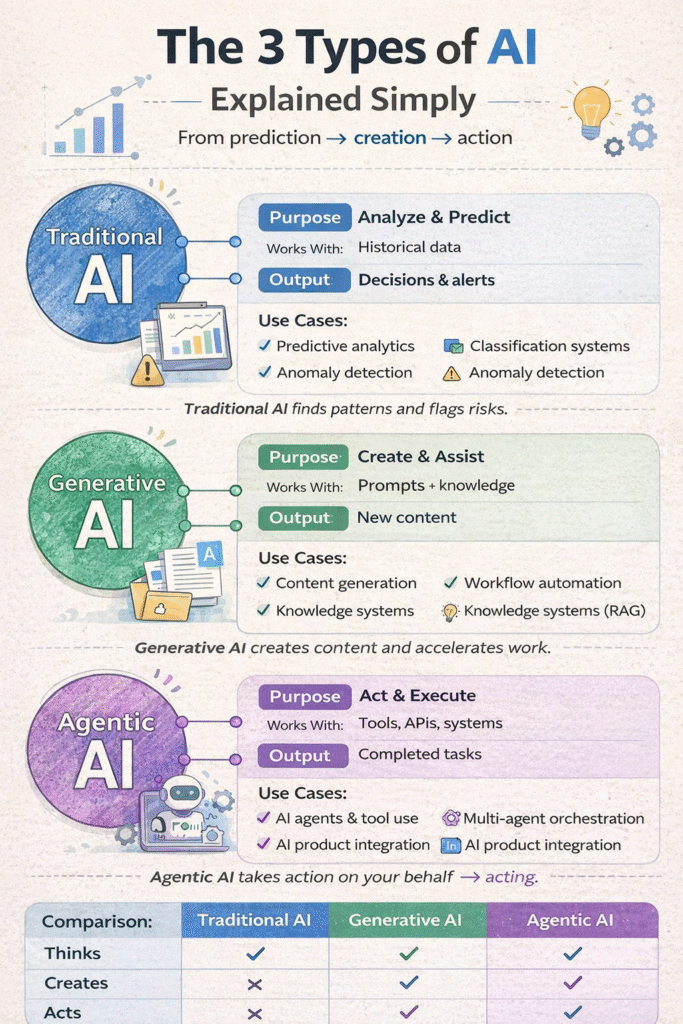
The easiest way to understand AI is to group it into three practical categories:
- Traditional AI
- Generative AI
- Agentic AI
Each serves a different purpose, solves different problems, and delivers value in different ways. Let’s break them down in plain language.
1. Traditional AI: Predict, Classify, Detect
Traditional AI focuses on analyzing historical data to make predictions, classifications, or detect anomalies. It is typically task-specific, rule-driven, and optimized for accuracy.
Core Use Cases
1. Predictive Analytics
Traditional AI can forecast future outcomes based on past data:
- Customer churn prediction
- Demand forecasting
- Risk assessment
This is widely used in finance, retail, supply chain, and insurance.
2. Classification Systems
Classification models automatically sort and label data:
- Email spam detection
- Support ticket routing
- Document categorization
The goal is efficiency and consistency.
3. Anomaly Detection
Anomaly detection identifies unusual behavior:
- Fraud detection
- System performance issues
- Cybersecurity breaches
These systems help organizations respond before problems escalate.
Best for: Structured data, operational efficiency, and decision support.
2. Generative AI: Create, Summarize, Transform
Generative AI is what most people think of when they hear “AI” today. Instead of just analyzing data, it creates new content based on prompts.
Core Use Cases
4. Content Generation
Generative AI can produce:
- Emails and reports
- Code snippets
- Marketing copy
- Images and designs
It accelerates work that previously required manual effort.
5. Workflow Automation
Beyond writing content, Generative AI helps automate knowledge-heavy tasks:
- Meeting summaries
- Email drafting and sorting
- Data cleaning and formatting
This improves productivity across teams.
6. Knowledge Systems (RAG)
Retrieval-Augmented Generation (RAG) allows AI to:
- Use internal documents and databases
- Answer business-specific questions
- Provide grounded, context-aware responses
This is especially valuable for internal tools and customer support.
Best for: Knowledge work, creativity, communication, and speed.
3. Agentic AI: Act, Decide, Coordinate
Agentic AI takes things a step further. Instead of waiting for a prompt, these systems take action autonomously to achieve goals.
Core Use Cases
7. AI Agents and Tool Use
AI agents can:
- Execute tasks via APIs
- Use tools and external systems
- Make decisions based on outcomes
For example, an agent could schedule meetings, run reports, and notify stakeholders automatically.
8. Multi-Agent Orchestration
Multiple agents can collaborate:
- Divide tasks
- Delegate responsibilities
- Coordinate complex workflows
This mirrors how human teams operate.
9. AI Product Integration
Agentic AI can be embedded directly into products:
- Customer-facing assistants
- Autonomous support workflows
- Intelligent enterprise platforms
This turns AI from a feature into a core capability.
Best for: End-to-end automation, complex processes, and scalable systems.
How These AI Types Fit Together
Rather than competing, these AI types build on each other:
- Traditional AI provides accuracy and structure
- Generative AI adds flexibility and creativity
- Agentic AI enables autonomy and execution
The most powerful systems combine all three.
Final Thoughts
AI does not need to be overwhelming.
When viewed through the lens of Traditional, Generative, and Agentic AI, it becomes much easier to:
- Choose the right tools
- Set realistic expectations
- Design effective AI strategies
The future of AI is not about replacing humans—it’s about augmenting intelligence, automating execution, and enabling better decisions at scale.