Introducing Claude Design by Anthropic Labs
Anthropic’s new visual collaboration tool reveals something bigger than a design feature — it’s a blueprint for how AI will absorb creative workflows entirely.
Source : https://www.anthropic.com/news/claude-design-anthropic-labs
Today, Anthropic launched Claude Design — a tool that lets you describe what you want visually and watch Claude build it: prototypes, pitch decks, landing pages, marketing assets, and more. It’s backed by Claude Opus 4.7, their most capable vision model, and it’s already in the hands of Pro, Max, Team, and Enterprise subscribers.
On the surface, it’s another AI design tool. But read the announcement carefully and a much more consequential story emerges.
The gap this fills
Design has always been a bottleneck in organizations that aren’t design-first. Product managers sketch on whiteboards. Founders describe visions in words. Marketers relay briefs through three layers of review. Even experienced designers face a harder constraint: time limits how many directions you can explore, so you always ship fewer ideas than you have.
Claude Design attacks all three of these problems at once. It doesn’t replace designers — it removes the waiting. You describe what you need, Claude builds a first draft, and refinement happens through conversation, inline comments, or custom sliders that Claude generates on the fly. The creative loop shrinks from days to minutes.
“What used to take a week of back-and-forth between briefs, mockups, and review rounds now happens in a single conversation.” — Datadog Product Manager
Who this is actually for
The announced use cases paint a clear picture of the target users. This is not just for designers — it’s explicitly positioned as a tool that gives everyone with an idea a path to visual output:
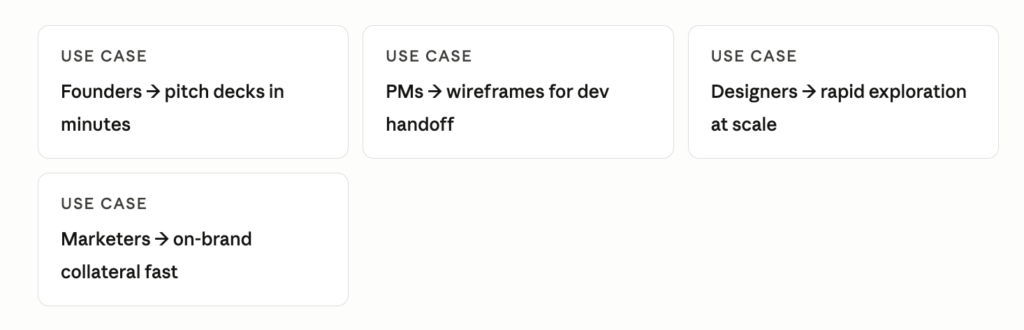
The breadth here is intentional. Anthropic isn’t building a niche design tool — they’re building infrastructure for visual thinking across an entire organization.
The brand system is the real moat
The feature that deserves more attention than it’s getting is the built-in brand system. During onboarding, Claude reads your codebase and design files to construct a design system — your colors, typography, components — and applies it automatically to every project thereafter. Teams can maintain multiple brand systems and update them over time.
This is significant for two reasons. First, it dramatically lowers the barrier to “on-brand” output, which has historically required either expensive design resources or painful manual review cycles. Second, and more importantly, it creates deep organizational stickiness. Once Claude understands your brand system, every visual output it produces is grounded in institutional context that a generic tool cannot replicate.
That’s a moat built not from model capability alone, but from organizational integration.
The Claude Code handoff loop
There’s another thread here that matters for anyone building software products. Claude Design doesn’t just produce static files — it packages completed designs into a handoff bundle that passes directly to Claude Code. One instruction. No reformatting, no spec documents, no Zeplin links.
This closes a loop that has frustrated product teams for years: the gap between “what design made” and “what engineering received.” When both tools speak the same language natively, that gap disappears.
Brilliant, one of the early adopters, described their most complex pages — which took 20+ prompts to recreate in other tools — requiring only 2 prompts in Claude Design. That’s not a marginal improvement. That’s a rethinking of what the design-to-code pipeline even looks like.
What this means for the industry
Claude Design arrives at a moment when the AI design tool space is crowded but fragmented. Tools like Figma AI, Canva Magic Studio, and a dozen well-funded startups are all chasing some version of the same idea. What sets Claude Design apart is its integration depth — it’s not a bolt-on AI feature inside an existing design tool. It’s a new primary surface built from scratch around conversational AI, with export paths to Canva, PPTX, PDF, and HTML baked in from day one.
The Canva partnership is notably well-chosen. Rather than trying to own publishing and distribution (a battle Canva has already won), Anthropic positioned Claude Design as the upstream creative layer. Generate and explore in Claude Design; polish and publish in Canva. That’s a clean division of responsibility that serves users without forcing a platform war.
The broader implication
What Anthropic is building, piece by piece, is a complete creative and technical operating system for knowledge workers. Claude writes and edits text. Claude Code builds software. Claude Design generates visual work. Each tool connects to the others. Each one gets better as it learns your organization’s context.
The endgame isn’t any individual feature. It’s a world where the bottleneck to executing ideas — writing, coding, designing — effectively disappears, and the only constraint that remains is the quality of the idea itself.
Claude Design is the latest piece of that architecture. It’s worth paying attention to not just because it’s useful today, but because of what it signals about where this is all going.
Claude Design is currently in research preview for Claude Pro, Max, Team, and Enterprise subscribers. Access is included with existing plan limits. You can start at claude.ai/design.