https://developers.googleblog.com/agents-cli-in-agent-platform-create-to-production-in-one-cli
Google’s Agents CLI: Why One CLI Could Change How AI Agents Move from Prototype to Production
AI agents are no longer just experimental scripts. Teams are now trying to ship them as reliable, secure, production-grade services. The problem is that the development lifecycle is still fragmented: local scaffolding, evaluation, infrastructure setup, CI/CD, deployment, and enterprise distribution often live in separate workflows.
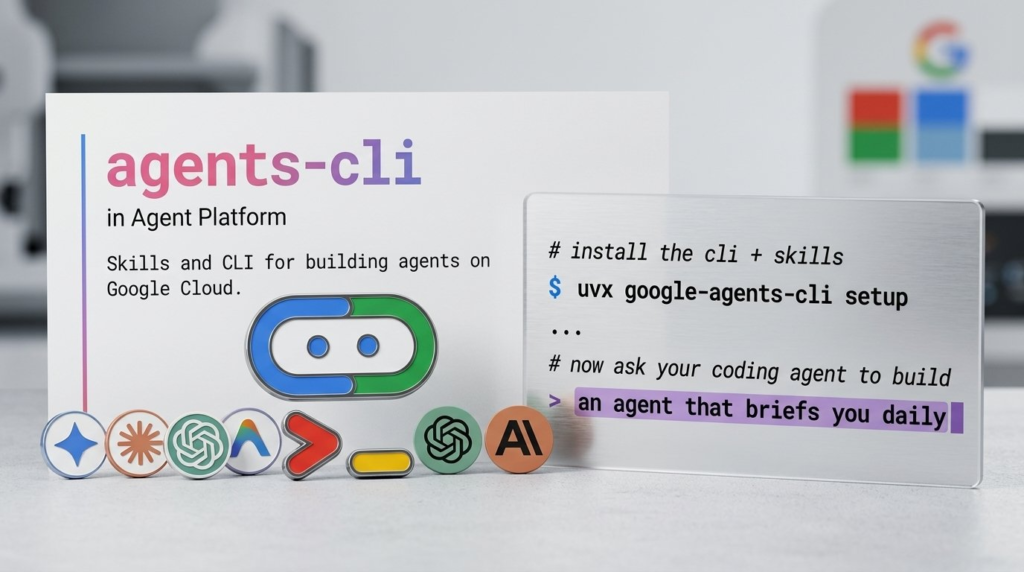
Google’s new Agents CLI in Agent Platform is designed to close that gap. It gives developers and AI coding assistants a single command-line interface for moving an agent from idea to production on Google Cloud. According to Google, the CLI connects into Agent Platform, Cloud Run, and A2A Integration, giving coding agents a machine-readable path through the Google Cloud agent stack. :contentReference[oaicite:1]{index=1}
What Google Announced
Agents CLI is a specialized CLI built for both human developers and AI coding assistants such as Gemini CLI, Claude Code, and Cursor. Instead of forcing an assistant to infer cloud architecture from scattered documentation, the CLI injects relevant skills, API references, and defaults directly into the development environment.
uvx google-agents-cli setup
From there, developers can scaffold an agent project, run evaluations, provision infrastructure, deploy to Google Cloud, and publish the agent for enterprise use.
The Core Problem: Agent Development Has Too Much Friction
The announcement is really about reducing lifecycle friction. Today, building an agent is not the hard part. Shipping one safely is.
- Developers need to scaffold projects correctly.
- Agents need evaluation harnesses before release.
- Infrastructure has to be provisioned securely.
- CI/CD pipelines must be configured.
- Deployment targets need to be managed.
- Enterprise distribution has to be handled cleanly.
Without a unified workflow, teams waste time connecting tools instead of improving agent behavior. Worse, AI coding assistants can burn tokens trying to understand disconnected documentation and infrastructure patterns.
What Agents CLI Enables
1. Faster Agent Scaffolding
Developers can use the CLI to create a new agent project with sensible defaults. Google’s example shows a finance-agent being created for Agent Runtime deployment:
agents-cli create finance-agent -y --deployment-target agent_runtime
cd finance-agent
This matters because scaffolding is where many agent projects become inconsistent. A standardized starting point makes it easier to enforce architecture, evaluation, and deployment conventions from day one.
2. Built-In Evaluation Workflows
Google emphasizes that agent logic is only half the battle. Teams also need to validate whether the agent behaves correctly before it goes live. Agents CLI supports evaluation runs and comparison between evaluation outputs.
agents-cli eval run
agents-cli eval compare evals/run_v1.json evals/run_v2.json
This is one of the most important parts of the announcement. Agent quality cannot be judged by demos alone. Evaluation needs to become part of the normal delivery pipeline.
3. Production Deployment from the Same Workflow
The CLI can also automate infrastructure and deployment tasks, including Infrastructure as Code generation, CI/CD setup, and deployment to Agent Runtime, Cloud Run, or GKE. :contentReference[oaicite:2]{index=2}
agents-cli infra single-project
agents-cli deploy
agents-cli publish gemini-enterprise
This is where the tool becomes strategically interesting. Google is not just offering a developer convenience; it is trying to define the default path for production agent delivery on Google Cloud.
Why This Matters for Engineering and Product Teams
The deeper implication is that agent development is becoming an operational discipline, not just an AI experimentation activity. Teams that want to deploy useful agents need repeatable patterns for development, testing, governance, and release management.
Agents CLI pushes agent work toward a more mature software delivery model:
- Standardized scaffolding instead of one-off prototypes.
- Evaluation-first delivery instead of demo-driven validation.
- Infrastructure automation instead of manual cloud setup.
- Human and agent modes so developers can combine deterministic control with AI-assisted execution.
- Enterprise publishing so deployed agents can be distributed beyond the development team.
The Critical Takeaway
The real value of Agents CLI is not that it adds another CLI to the ecosystem. The value is that it compresses the agent development lifecycle into a single, repeatable path.
For organizations building AI agents, this is the direction to watch: agent platforms will increasingly compete on lifecycle completeness, not just model access. The winning platforms will help teams move from prompt experiments to governed, observable, production-grade systems.
Who Should Pay Attention
- Engineering leaders evaluating how to standardize agent development.
- Product managers planning agent-enabled workflows for enterprise users.
- Cloud architects responsible for deployment, governance, and runtime strategy.
- AI developers using coding assistants to build agentic applications.
- Platform teams looking to reduce prototype-to-production friction.
Final Thoughts
Google’s Agents CLI is a strong signal that AI agent development is entering its platform engineering phase. The early question was, “Can we build an agent?” The more important question now is, “Can we build, evaluate, deploy, and operate agents reliably?”
Agents CLI is Google’s answer: one CLI for the agent lifecycle, built for both human developers and AI coding assistants.