Creating a successful YouTube channel involves much more than recording a video.
Behind every published video are multiple activities:
- Finding relevant topics
- Researching trends
- Writing scripts
- Producing visual assets
- Creating thumbnails
- Optimizing titles and descriptions
- Publishing content
- Scheduling videos
- Monitoring performance
- Improving future content
Traditionally, these responsibilities require either one creator spending significant time on every video or a team of writers, designers, editors, and marketers.
An interesting open-source project called Lumen YouTube Automation Agent is experimenting with a very different approach: assigning these responsibilities to specialized AI agents and orchestrating them as a complete content-production workflow.
The project is available on GitHub under the MIT license and has attracted more than 2,000 GitHub stars as interest in agentic AI automation continues to grow.
What Is the Lumen YouTube Automation Agent?
Lumen is an open-source YouTube channel automation platform designed to automate large portions of the content lifecycle using specialized AI agents.
Instead of sending one giant prompt to an AI model and asking it to “create a YouTube video,” the system breaks the problem into separate responsibilities.
The repository contains dedicated agents for:
- Content strategy
- Script writing
- Thumbnail design
- SEO optimization
- Production management
- Publishing and scheduling
- Analytics and optimization
The architecture therefore resembles a small digital content team, where each AI agent has a particular responsibility and passes its output into the broader workflow.
This is an important distinction.
AI automation is moving from individual prompts toward coordinated workflows consisting of multiple specialized agents.
How the Multi-Agent Workflow Works
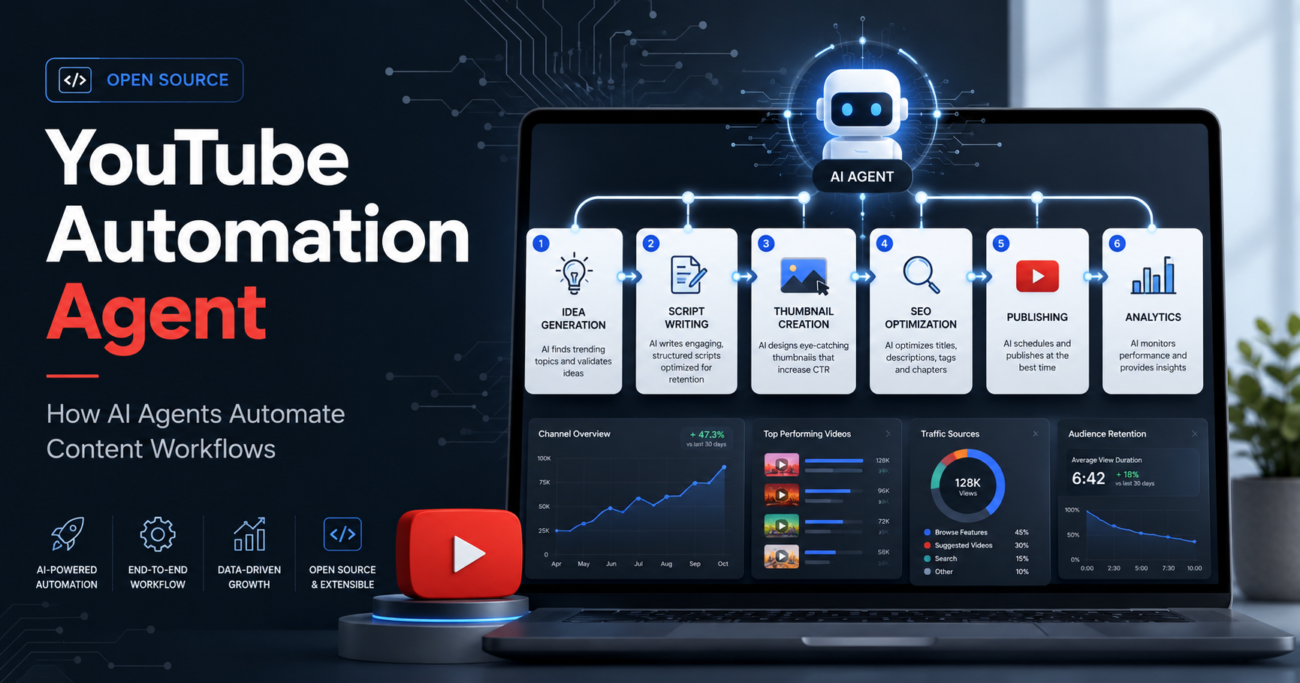
A simplified content lifecycle looks something like this:
Content Strategy → Script → Media Production → Thumbnail → SEO → Review → Publishing → Analytics → Optimization
Each stage can be handled by a specialized component rather than relying on one AI model to perform everything.
1. Content Strategy Agent
The first problem for any content creator is deciding what to publish.
A strategy agent can help identify topics, evaluate ideas and create a content pipeline aligned with the channel’s target audience.
The interesting part is that the channel can also be configured with persistent brand information such as:
- Target audience
- Channel objective
- Brand voice
- Calls to action
- Visual direction
- Time zone
- Topics that should not be discussed
These become guardrails that influence the downstream AI agents.
2. Script Writing Agent
Once a topic has been selected, the script-writing agent generates the content.
Instead of starting every video from a blank page, the system can create a structured draft that follows the configured channel style.
For creators, this could significantly reduce one of the biggest bottlenecks in content production: moving from an idea to a usable script.
Human review still matters, particularly for factual accuracy, tone and originality.
3. AI-Powered Media Generation
The platform can integrate with different AI services to create media for a video.
One particularly interesting feature is its support for multiple AI providers rather than locking the application into a single model.
The repository currently describes support for providers and integrations including:
- Google Gemini
- OpenAI
- OpenRouter
- Kimi
- MiMo
- GLM
- Anthropic Claude
- ElevenLabs
- Replicate
- Local models through Ollama
It also supports OpenAI-compatible endpoints.
This provider abstraction is one of the more valuable architectural ideas in the project.
Instead of building the entire automation around one AI company, developers can potentially select different models based on cost, quality or a particular task.
Gemini Can Power Much of the Pipeline
Another noteworthy element is the project’s Google Gemini integration.
The repository describes a Gemini-based pipeline capable of supporting AI reasoning as well as image and voice-generation functions. Gemini can therefore participate in multiple stages of content production rather than simply generating the script.
For developers experimenting with AI automation, this demonstrates an important architectural trend:
Multimodal models are increasingly becoming workflow engines rather than just chatbots.
A single AI ecosystem can potentially contribute to:
Research → Writing → Images → Narration → Content Assembly
while specialized services can still be introduced where higher-quality output is required.
Human Approval Is an Important Addition
Fully autonomous publishing sounds attractive, but it introduces significant risk.
Incorrect facts, questionable media rights, inappropriate topics or simply low-quality AI output could otherwise be uploaded automatically.
The project’s newer workflow addresses this by introducing an approval-first publishing model.
Generated content can be reviewed for:
- Quality
- Factual accuracy
- Media rights
- Metadata
- Scheduling
- Final human approval
The system also includes a review interface where operators can preview videos and thumbnails and modify titles, descriptions, tags, privacy settings and schedules before publication.
This is the right direction for agentic systems.
The strongest enterprise-grade AI automation architecture is rarely:
AI → Action
It is more commonly:
AI → Generate → Validate → Human Approval → Action
That extra governance layer becomes increasingly important as agents receive permission to interact with external systems.
The Dashboard Turns the Agents Into an Operating System
The project also includes a local management dashboard.
According to the current project documentation, the dashboard brings several capabilities into one console, including:
- Active jobs
- Content pipeline
- Review queue
- Publishing calendar
- Idea backlog
- Analytics
- Channel configuration
- Automation controls
Generation tasks can operate asynchronously, meaning that a request does not have to remain connected to a browser while a video is produced. Jobs receive persistent IDs and their progress, failures and cancellations can be tracked.
This is another important lesson for developers building production AI agents.
A production agent platform needs more than an LLM.
It also needs:
Agents + Jobs + State + Database + Monitoring + Human Review + External Integrations
That infrastructure is what converts an AI demonstration into an operational application.
Under the Hood
The application is primarily a Node.js project.
Its repository separates the application into logical areas including:
agents/
config/
database/
data/
schedules/
utils/
SQLite is used for application data, while scheduled automation is handled separately. The application also includes an Express-based backend and integrations with Google’s AI and authentication libraries.
The basic installation process is relatively straightforward:
git clone https://github.com/darkzOGx/youtube-automation-agent.git
cd youtube-automation-agent

npm install
npm run walkthrough
npm start
The local dashboard then runs on port 3456. Node.js 18 or newer is listed as a prerequisite, while FFmpeg is used for media processing.
Why This Project Is More Interesting Than Just YouTube Automation
The real value of this repository is not necessarily whether someone should completely automate a YouTube channel.
It demonstrates a broader AI architecture that can apply to many business processes.
Consider the pattern:
Research Agent
↓
Content/Document Agent
↓
Quality Agent
↓
Approval Workflow
↓
Publishing/Action Agent
↓
Analytics Agent
The exact same architecture could potentially be adapted for:
Marketing Automation
Research trends → Create campaigns → Generate graphics → Approve → Publish → Analyze results
Proposal Management
Analyze an RFP → Extract requirements → Generate responses → Validate compliance → Human review → Assemble proposal
Procurement
Analyze requirements → Research vendors → Compare responses → Generate recommendations → Human approval
Customer Service
Understand request → Search enterprise knowledge → Generate response → Escalate when required → Track resolution
Sales
Research prospect → Generate outreach → Review → Send → Monitor response → Schedule follow-up
That is why projects like Lumen are useful even if you never plan to operate an automated YouTube channel.
They provide a practical reference architecture for understanding agentic AI systems.
Where You Should Be Cautious
It would be a mistake to interpret “YouTube automation” as meaning a completely hands-off content business.
AI can reduce production effort, but several responsibilities still need human oversight.
Content Quality
AI-generated scripts can sound generic unless the system has strong source material, brand guidelines and editorial oversight.
Hallucination and Accuracy
Research-heavy videos require fact checking before publishing.
Copyright and Media Rights
Generated or externally sourced imagery, audio and video still need appropriate rights verification.
API Costs
The software may be open source, but some AI, video-generation, voice-generation and infrastructure services can carry usage costs.
Platform Risk
Automated publishing must still comply with YouTube’s Terms of Service and Community Guidelines, which the project itself explicitly notes.
Security
API keys and YouTube credentials give the system meaningful access to external platforms.
These credentials should be protected carefully, particularly before deploying an automation platform on a public server.
The project’s example configuration supports environment variables for AI providers, YouTube configuration and optional media services.
The Bigger Trend: From AI Assistants to AI Operations
For the past few years, most AI adoption has focused on asking a chatbot to generate something.
Write an email.
Summarize a document.
Generate an image.
Create some code.
Agentic systems are changing that model.
Instead of asking AI to produce one output, we can increasingly define an objective and create a workflow where multiple AI agents collaborate to achieve it.
Lumen demonstrates this shift particularly well.
The interesting technology isn’t the script writer.
It isn’t the thumbnail generator.
It isn’t even the publishing automation.
The important part is the orchestration connecting all of these capabilities into one operational workflow.
That is ultimately where a large part of AI innovation is heading.
Final Thoughts
The Lumen YouTube Automation Agent is an interesting open-source experiment in what happens when AI moves beyond content generation and begins operating an entire workflow.
Its combination of specialized agents, multiple AI providers, media generation, scheduling, human approvals and analytics provides a practical example of an emerging architecture for agentic applications.
For creators, it could be an interesting platform for experimenting with automated content production.
For developers and businesses, however, the bigger lesson is broader:
If AI agents can coordinate research, writing, production, approval, publishing and analytics for a YouTube channel, the same architectural pattern can be applied to many knowledge-work processes inside a business.
And that may ultimately be much more important than automating YouTube itself.
Project: Lumen YouTube Automation Agent
Source: GitHub – darkzOGx/youtube-automation-agent
License: MIT