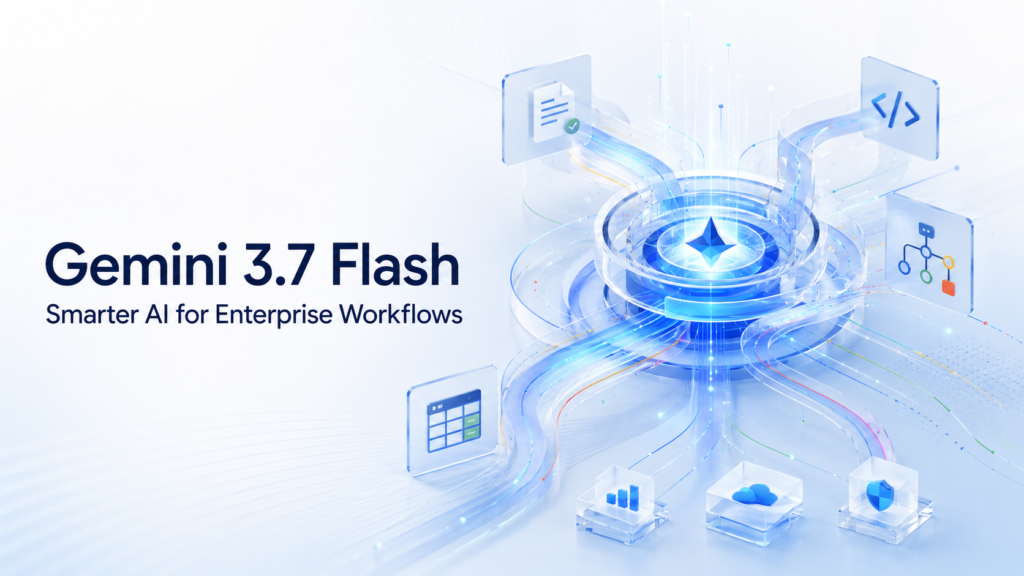
Google has introduced Gemini 3.7 Flash, its latest AI model designed for coding, intelligent agents, and complex enterprise workflows. The release reflects a significant shift in how organizations can use AI—not simply to generate content or answer questions, but to plan, use tools, analyze documents, and execute multi-step business processes.
Gemini 3.7 Flash is positioned as Google’s most intelligent “workhorse” model to date, combining advanced reasoning with the speed and cost efficiency organizations need for production-scale AI solutions.
What Makes Gemini 3.7 Flash Different?
Organizations have traditionally faced a trade-off when selecting an AI model: use a larger model for complex reasoning or choose a smaller, faster model for high-volume workloads.
Gemini 3.7 Flash is intended to narrow that gap. It offers stronger reasoning and agentic capabilities while maintaining the responsiveness and economics associated with Google’s Flash model family.
According to Google, the model delivers improvements in:
- Multi-step planning and task execution
- Software engineering and code generation
- Complex document comprehension
- Enterprise workflow automation
- Tool usage and instruction following
- Recovery from unexpected roadblocks
- Multimodal understanding
These improvements are especially important for organizations moving from isolated AI experiments to operational systems that interact with documents, applications, data sources, and employees.
Stronger Performance for Complex Documents
Enterprise information rarely arrives as clean, structured data. It is often distributed across contracts, policies, invoices, reports, scanned records, spreadsheets, knowledge repositories, and line-of-business applications.
Google reports that Gemini 3.7 Flash achieved 34% on its GDP.pdf document-comprehension benchmark, compared with 22% for Gemini 3.6 Flash. While benchmarks should not replace testing with an organization’s own data, the improvement suggests greater potential for knowledge-intensive sectors such as government, finance, legal services, healthcare, procurement, and life sciences.
Organizations could apply these capabilities to use cases such as:
- Reviewing contracts and procurement documents
- Extracting information from invoices and forms
- Summarizing policies, procedures, and case records
- Comparing requirements across large document sets
- Supporting compliance and regulatory reviews
- Creating grounded answers from enterprise knowledge
The real opportunity is not document summarization by itself. It is connecting document intelligence to a broader workflow—for example, identifying missing information, validating it against business rules, routing an exception, and preparing the next action for human approval.
More Capable Enterprise Workflow Automation
Gemini 3.7 Flash also showed a reported improvement on AutomationBench, increasing from 17% with Gemini 3.6 Flash to 30.4%.
This matters because enterprise workflows are rarely completed with a single prompt. A useful AI agent may need to interpret a request, locate supporting information, decide which tools to use, complete several steps, validate the result, and escalate exceptions.
Potential applications include:
- Procurement request review and vendor validation
- IT service request categorization and resolution support
- Constituent or customer service automation
- Employee onboarding and offboarding
- Project status consolidation
- Compliance evidence gathering
- Case intake and document processing
- Knowledge and records management
Gemini 3.7 Flash is designed to follow instructions more reliably, use tools more effectively, and adapt when it encounters roadblocks. These improvements can reduce retries and manual intervention, although organizations should still retain human approval for financial, legal, security-sensitive, or high-impact decisions.
A Better Foundation for Enterprise AI Agents
The next phase of enterprise AI will be defined by agents that can take controlled action across business systems.
A production-ready agent requires more than a capable model. It also needs:
- Secure access to approved enterprise information
- Clearly defined permissions and operational boundaries
- Integration with existing applications
- Identity and access management
- Logging, monitoring, and auditability
- Human review and escalation controls
- Testing against realistic business scenarios
- Governance for data, security, privacy, and responsible AI
Gemini 3.7 Flash can serve as the reasoning and orchestration layer within this larger architecture. Enterprises can access it through the Gemini Enterprise Agent Platform and Gemini Enterprise app, while developers can build with the Gemini API and Google AI Studio.
The model can therefore support both employee-facing AI assistants and custom agents embedded within business applications and workflows.
Improved Economics for Production AI
Google is offering Gemini 3.7 Flash through the end of 2026 at an introductory API price of:
- $0.75 per one million input tokens
- $3.75 per one million output tokens
The pricing can make high-volume AI workloads more practical, but token pricing is only one part of the total cost.
Organizations should also evaluate:
- Data preparation and integration
- Search and grounding infrastructure
- Application hosting
- Identity and security controls
- Monitoring and evaluation
- Human review requirements
- Ongoing maintenance and governance
A less expensive model does not automatically create a lower-cost solution. Poorly designed workflows can generate unnecessary model calls, duplicate processing, and unreliable results. The strongest implementations use model routing, caching, structured outputs, targeted retrieval, and human approval points to balance cost, speed, and accuracy.
What Should Organizations Do Next?
Gemini 3.7 Flash should not trigger an immediate model replacement across every AI application. Organizations should begin with controlled evaluation.
A practical adoption approach includes:
- Select two or three high-value workflows with measurable outcomes.
- Establish baseline results using the current process or model.
- Test Gemini 3.7 Flash using representative organizational data.
- Measure accuracy, completion rate, response time, cost, and required human intervention.
- Conduct security, privacy, and responsible-AI reviews.
- Pilot the solution with a limited group of users.
- Scale only after the workflow demonstrates reliable business value.
Organizations already using Gemini models should perform regression testing before migration. Better benchmark performance does not guarantee better results for every prompt, integration, document type, or operational environment.
The Bottom Line
Gemini 3.7 Flash represents more than an incremental model update. Its combination of improved reasoning, document understanding, tool usage, workflow execution, and introductory pricing makes it a strong candidate for enterprise AI agents and automation solutions.
However, the model is only one component of a successful AI program. Sustainable value comes from selecting the right use case, connecting trusted organizational data, establishing appropriate controls, and measuring operational outcomes.
At Global Solutions Group, we help public-sector and enterprise organizations identify high-value AI opportunities, design secure agentic solutions, integrate AI with existing systems, and move from proof of concept to governed production deployment.
If your organization is evaluating Gemini Enterprise, intelligent document processing, AI-powered workflow automation, or custom enterprise agents, contact our team to explore a practical implementation roadmap.
The product details, Google-reported benchmarks, availability, and introductory pricing are based on Google’s official Gemini 3.7 Flash announcement.