An AI application can return a good answer in a demonstration and still fail in production. Prompts change. Models are upgraded. Retrieval starts returning the wrong documents. An agent calls the wrong tool. Costs rise while nobody can explain which workflow caused the increase.
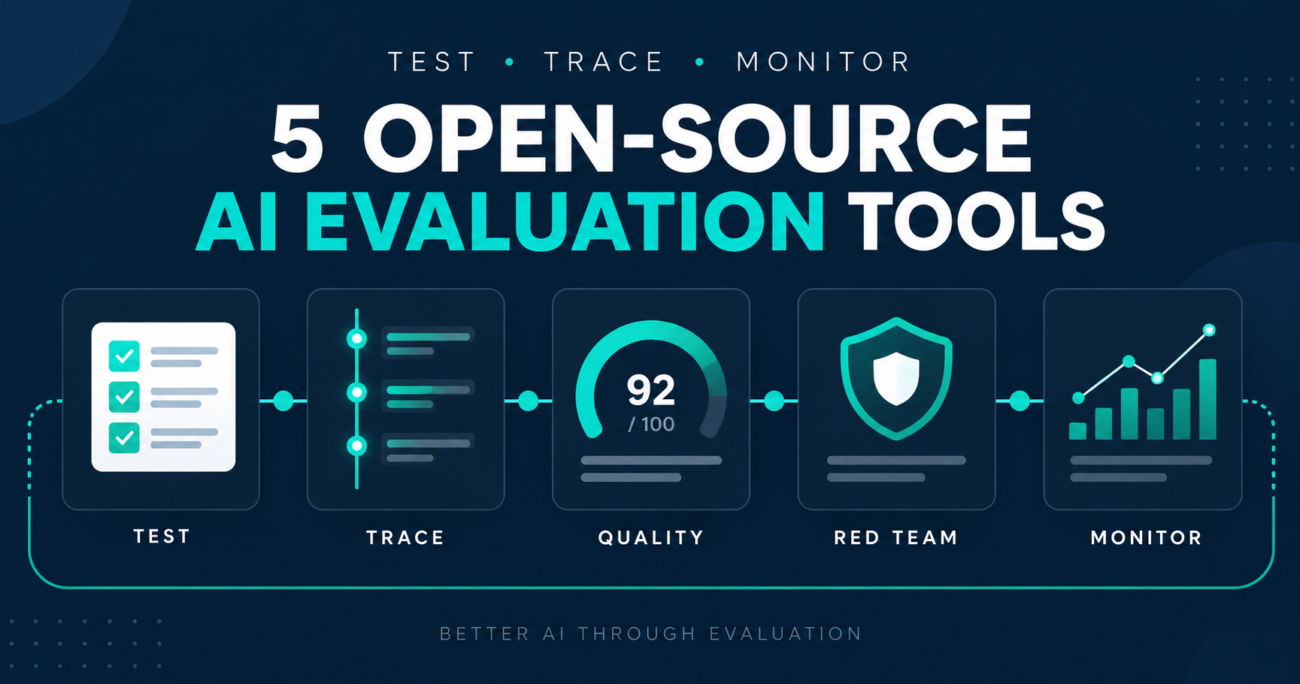
Traditional software tests remain necessary, but they do not measure whether an answer is grounded, relevant, safe, or useful. Teams need repeatable evaluation datasets, trace visibility, production monitoring, and adversarial tests. The five projects in this guide approach that problem from different angles.
This is not a popularity ranking. The selection considers current maintenance, release activity, documentation, license, deployment burden, integrations, security posture, commercial-use implications, and usefulness for small businesses, developers, technical project managers, and public-sector teams. Repository facts were checked on September 11, 2026. AIXYZ reviewed the repositories and official documentation but did not independently deploy or benchmark the tools for this article.
Quick verdict: Choose Langfuse for a broad observability platform, Opik when a fully Apache-licensed self-hosted platform is important, DeepEval for Python-first automated evaluation, Promptfoo for prompt testing and red teaming in CI, and Ragas for focused RAG evaluation and test-data work. Many mature teams will use one platform plus one test framework rather than force a single tool to do everything.
Comparison at a glance
| Tool | Best for | License position | Deployment profile | Main limitation |
|---|---|---|---|---|
| Langfuse | End-to-end tracing, prompt management, datasets and evaluations | MIT core; separate ee code | Docker Compose, VM, Kubernetes or managed cloud | Production self-hosting has several services; enterprise boundaries require review |
| Opik | Fully self-hostable observability and evaluation platform | Apache-2.0 platform | Local installer/Docker Compose, Kubernetes or cloud | Broader platform means more administration than a library |
| DeepEval | Pytest-style unit tests for LLM, RAG and agent behavior | Apache-2.0 framework | Python package; optional commercial platform | The open-source framework is not a complete self-hosted monitoring dashboard |
| Promptfoo | Prompt comparison, release gates and AI red teaming | MIT | CLI, local viewer, CI/CD and enterprise options | Node.js-centric workflow; test results still depend on evaluator design |
| Ragas | RAG metrics, test generation and experimentation | Apache-2.0 | Python package | More toolkit than operations platform; API evolution requires version discipline |
Repository snapshot
GitHub counts below are a dated snapshot, not a quality score.
| Repository | Stars | Forks | Latest release or recent activity verified |
|---|---|---|---|
| Langfuse | 34.5k | 3.8k | v4.35.0 released September 11, 2026 |
| Opik | 21.9k | 1.8k | v2.2.59 released September 11, 2026 |
| DeepEval | 18.2k | 1.9k | Python v4.2.0 released August 24, 2026; active commits followed |
| Promptfoo | 25.0k | 2.3k | v0.123.0 released September 10, 2026 |
| Ragas | 15.7k | 1.7k | v0.4.3 released January 13, 2026; repository remained active afterward |
All five repositories were active and not archived when reviewed. Frequent releases are evidence of maintenance, but they also create upgrade risk. Pin versions and run regression tests instead of installing an unreviewed latest image in production.
1. Langfuse: best all-around observability platform
Langfuse combines traces, prompt management, evaluations, datasets, experiments, user feedback, and a playground. It supports Python and JavaScript/TypeScript SDKs, OpenTelemetry, and integrations with popular application frameworks and model gateways.
The practical advantage is continuity. A team can inspect a failed production trace, add the case to a dataset, compare a revised prompt or model, and watch the new version after deployment. That is more useful than keeping test results in one system and production traces in another.
Best for: product teams that want one place for development experiments and production observability; technical project managers who need evidence of quality trends; organizations already using OpenTelemetry; and teams willing to operate a data platform.
Not ideal for: a developer who only needs a lightweight command-line release gate, or a small team that cannot maintain the databases and storage behind a production deployment.
Deployment requirements: The project documents Docker Compose for local or single-VM use and Kubernetes/Helm for production. Its current architecture uses ClickHouse for analytics and additional persistence, cache and object-storage components. No GPU is required for Langfuse itself. Evaluation jobs that call an LLM may create provider cost or require separate local-model hardware.
License and commercial use: The repository states that the core is MIT-licensed except for ee folders. That is open-core, not a blanket MIT license for every feature. Map required SSO, governance, support and enterprise functions before promising a zero-license-cost deployment.
2. Opik: best permissively licensed self-hosted platform
Opik, built by Comet, provides tracing, datasets, experiments, LLM-as-a-judge evaluations, prompt management, online evaluation rules, dashboards, agent optimization and guardrail-related capabilities. Its repository includes the server and web application under Apache 2.0.
That licensing position is the differentiator. Buyers evaluating self-hosting often discover that an “open-source” SDK feeds a commercially licensed server. Opik’s repository explicitly describes the complete observability and evaluation platform as Apache-2.0 and free to self-host.
Best for: organizations that require a permissive license across the core self-hosted platform; engineering teams monitoring RAG or agent workflows; and buyers that want to avoid a single-framework dependency.
Not ideal for: teams that only need test assertions in an existing Python suite. Operating a full platform adds backups, upgrades, access management, storage sizing and monitoring.
Deployment requirements: Opik supports local and infrastructure deployments, including Docker-based and Kubernetes paths. The server does not inherently require a GPU, but judge models and production volume drive external API usage, compute, storage and retention costs.
License and commercial use: Apache 2.0 generally allows commercial use, modification and distribution while preserving notices and license terms. It also includes an express patent grant. Counsel should still review dependencies, trademarks, hosted-service terms and any enterprise additions.
3. DeepEval: best for Python unit testing
DeepEval treats LLM evaluation like software testing. Developers define test cases and metrics, then run them through a Pytest-oriented workflow. Available areas include answer relevancy, faithfulness, contextual recall and precision, hallucination, multi-turn behavior, task completion, tool correctness and agent trajectories.
DeepEval is compelling when quality gates belong beside application code. A pull request can fail when a revised prompt falls below the approved threshold. The team can version its test dataset and evaluation configuration with the product rather than depend entirely on manual dashboard review.
Best for: Python teams, automated regression suites, RAG evaluation, agent-step testing and developers comfortable expressing quality requirements as code.
Not ideal for: nontechnical reviewers expecting a complete shared production-operations console from the open-source package. Confident AI offers a separate platform for collaboration and monitoring; confirm the commercial boundary.
Deployment requirements: Install the Python package and connect approved evaluator models. The framework can use local or external models depending on configuration. Hardware requirements are modest for orchestration, but local judge models may need substantial RAM or GPU capacity.
License and commercial use: The framework is Apache-2.0. Commercial use is generally permitted subject to the license, notices and dependency obligations. The open-source framework should not be confused with every capability of the associated hosted platform.
4. Promptfoo: best for red teaming and CI release gates
Promptfoo uses declarative configurations to compare prompts, models and providers. It supports automated assertions, side-by-side results, CI/CD checks and adversarial testing for LLM applications, agents and RAG systems.
The project’s official quick start currently requires Node.js 22.22 or newer for npm and npx, with Node.js 24 LTS recommended. Version 0.123.0, released September 10, added new provider capabilities and included a breaking provider change—exactly why production teams should pin versions and review changelogs.
Best for: developers who need a fast local test harness, security teams building repeatable red-team suites, projects comparing several model providers, and release pipelines that must block a known regression.
Not ideal for: organizations looking primarily for long-term production tracing and operational dashboards. Promptfoo is strongest as a test and security layer, even when paired with another observability system.
Deployment requirements: The CLI can run locally or in CI, with API keys supplied through protected environment variables or secret managers. Promptfoo says evaluations run locally, but requests still go to configured model providers. Local execution does not by itself guarantee that prompt data remains on the device.
License and commercial use: Promptfoo remains MIT-licensed. Its repository states that the project is now part of OpenAI while remaining open source. Evaluate future releases by their actual license and release notes rather than assuming ownership can never affect packaging.
5. Ragas: best focused toolkit for RAG evaluation
Ragas, formerly under the Exploding Gradients organization, focuses on measuring and improving retrieval-augmented generation. It offers LLM-based and traditional metrics, test-data generation, experiments, and integrations with common AI frameworks and observability tools.
Ragas fits teams that need to separate retrieval quality from answer quality. A poor response may come from missing context, weak ranking, or generation that ignores good evidence. Metrics such as faithfulness, context relevance, precision and recall help structure that diagnosis.
Best for: RAG prototypes, evaluation notebooks, offline experiments, synthetic test generation and teams building their own evaluation pipeline.
Not ideal for: organizations that need a turnkey multi-user monitoring service, enterprise identity, workflow approvals or a finished executive dashboard.
Deployment requirements: Ragas installs as a Python package. The toolkit itself does not require a GPU, but configured judge and embedding models determine compute, privacy and cost. The project documents anonymized analytics and an opt-out environment variable; privacy-sensitive teams should review and set telemetry explicitly.
License and commercial use: Ragas is Apache-2.0. The January stable release and subsequent repository changes suggest active development, but teams should pin a tested version because evaluation APIs and metric behavior can evolve.
Which tool should you choose?
Start with the failure you need to control:
- Choose Langfuse when production traces must become evaluation datasets and prompt experiments.
- Choose Opik when permissive licensing for the full self-hosted platform is a procurement requirement.
- Choose DeepEval when developers want quality assertions inside Python tests.
- Choose Promptfoo when model comparison, prompt regression and adversarial testing must run in CI.
- Choose Ragas when retrieval quality is the central question and you want composable Python metrics.
A sensible small-team stack is often Promptfoo or DeepEval for pre-release testing plus Langfuse or Opik for production tracing. Ragas can supply specialized RAG metrics. Do not deploy three dashboards because three projects look impressive; every platform adds credentials, data retention, patches and operational work.
A practical 30-day evaluation plan
Week 1: define the quality contract
Select 50 to 100 representative cases. Include normal questions, missing-answer cases, ambiguous inputs, sensitive data, prompt injection, wrong-tool attempts and permission boundaries. Define pass thresholds and critical failures before running tools.
Week 2: test two candidates
Instrument one application path and configure the same dataset in both candidates. Measure setup time, trace completeness, evaluator repeatability, latency, model cost and the effort required to explain a failed result.
Week 3: connect release and production evidence
Add a small CI gate and send production-like traces to a test environment. Confirm secret handling, role access, deletion, retention, backup, export and upgrade procedures. For government data, involve privacy, security, records and accessibility stakeholders early.
Week 4: decide using evidence
Score each candidate across evaluation coverage, operational fit, license, total cost, data path, usability, integration effort and exit options. Use AIXYZ’s 15-point AI tool evaluation checklist and 30-day AI pilot guide.
Risks teams routinely underestimate
LLM judges are not ground truth. Their scores can change with the judge model, prompt and sampling configuration. Calibrate automated metrics against human-reviewed examples.
Observability data can be more sensitive than the application database. Traces may contain prompts, retrieved documents, personal information, tool arguments and model outputs. Apply minimization, masking, encryption, access control and retention limits.
Evaluation can become expensive. A matrix of 100 cases, five prompts, three models and two judge calls creates thousands of requests. Set budgets and cache safely.
A passing average can conceal a critical failure. Track safety, privacy and authorization failures separately. One cross-tenant disclosure cannot be averaged away by 99 correct answers.
Open source does not eliminate lock-in. Instrument through OpenTelemetry where practical, preserve datasets in portable formats, and test exports before committing. Review AIXYZ’s AI incident-response guide before production launch.
Frequently asked questions
What is the best open-source AI evaluation tool?
There is no universal winner. Langfuse and Opik are broader platforms; DeepEval and Promptfoo fit automated testing; Ragas specializes in RAG evaluation. Choose according to the failure mode, deployment model and license you need.
Do these tools require a GPU?
The orchestration, dashboards and test runners generally do not. A GPU may be required when evaluator, embedding or application models run locally. Hosted judge models shift that requirement into API cost and data-transfer considerations.
Can AI evaluations run entirely on premises?
Yes, if the tool, storage, application, judge models and embeddings are all hosted locally and external telemetry is disabled. Self-hosting the dashboard while sending prompts to a cloud model is not an entirely on-premises design.
Are GitHub stars a reliable selection criterion?
No. Stars indicate visibility and community interest. Maintenance activity, release quality, issue handling, documentation, license, security process, portability and operational fit matter more.
Is Phoenix an open-source alternative?
Arize Phoenix is a capable self-hostable observability and evaluation project, but its current repository uses Elastic License 2.0. ELv2 is source-available and not an OSI-approved open-source license, so it was excluded from this open-source list. It may still be a valid evaluation candidate if its terms fit your use case.
Can these tools prove an AI system is compliant?
No. They can produce useful traces, test results and monitoring evidence, but compliance also requires governance, risk assessment, access controls, documentation, human oversight and jurisdiction-specific review.
Final recommendation
For most organizations, begin with the smallest combination that covers pre-release testing and production diagnosis. Promptfoo plus Langfuse is a strong cross-language pattern; DeepEval plus Opik is compelling for Python teams that prioritize permissive licensing across the platform. Ragas is valuable when retrieval quality needs deeper analysis.
Run a controlled bake-off against your own failures. Pin versions, verify license boundaries, secure trace data, and require evaluators to demonstrate why a result failed. The best tool is not the one with the biggest repository. It is the one your team can operate, audit and use to prevent a bad release.
Call to action: Select two candidates, reuse the same 50-case dataset, and complete a 30-day evaluation before standardizing your AI quality stack.