Most AI pilots fail for a predictable reason: the organization starts with a tool instead of a business problem.
A manager sees an impressive demonstration, buys a few licences and tells the team to “find ways to use AI.” Thirty days later, employees have generated some emails and summaries, but nobody can prove whether the tool saved money, improved service or created new risk.
That is not a pilot. It is unstructured experimentation.
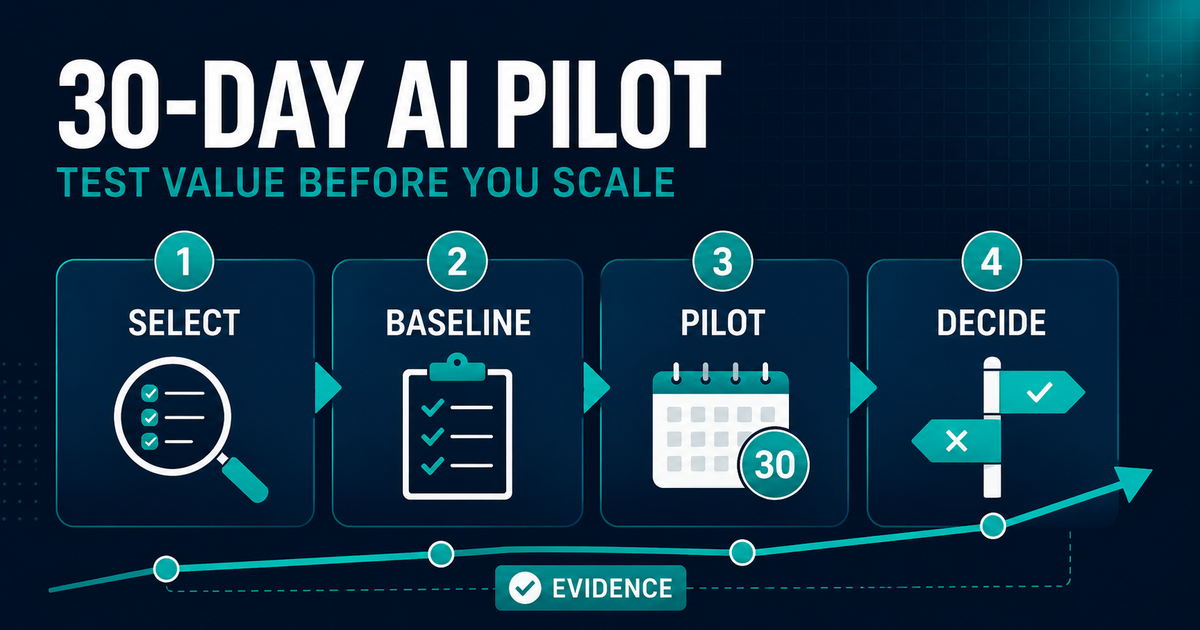
A useful AI pilot compares AI-assisted work with the current process, measures value and failure, and produces a decision: scale, revise or stop.
This guide presents a practical 30-day AI pilot plan for small and mid-sized businesses. It can also be adapted by project managers and public-sector teams that need a disciplined path from interest to evidence.
Important: The 30-day structure in this article is a practical AIXYZ recommendation, not a legal, regulatory or NIST requirement. High-impact, regulated or technically complex systems may require a longer evaluation and specialized privacy, security, legal or accessibility review.
What Is an AI Pilot?
An AI pilot is a limited test of a defined use case with representative users, real operating conditions and measurable success criteria.
It is different from a proof of concept.
| Approach | Main question | Typical output |
|---|---|---|
| Demo | What can the product show? | A guided presentation |
| Proof of concept | Can the technology perform the core task? | A technical result |
| Pilot | Does it create reliable value in our workflow? | Operational evidence |
| Production rollout | Can we operate it safely and sustainably at scale? | A managed business capability |
A proof of concept may show that AI can summarize a report. A pilot determines whether employees can use it accurately with company documents and whether it improves the current process.
The distinction matters. Technical capability does not automatically create business value.
Why Use a 30-Day Structure?
For many low- to moderate-risk use cases, 30 days is enough to produce evidence while limiting wasted investment. The deadline forces the team to:
- Choose one use case instead of attempting an enterprise transformation
- Define success before testing
- Establish a comparison baseline
- Include representative users
- Document failures as well as successes
- Make a decision rather than allowing the pilot to continue indefinitely
High-impact employment, clinical, legal or safety uses require deeper assessment. Start with work that assists people rather than replacing accountable decision-makers.
Before Day 1: Select the Right Use Case
The best first pilot is rarely the most ambitious idea. It is a recurring, measurable task with accessible data, manageable risk and a clear owner.
Good starting examples include:
- Drafting responses to common, non-sensitive customer questions
- Searching an approved internal knowledge base
- Summarizing public or approved internal documents
- Extracting fields from standard, low-risk forms
- Creating first drafts of project status reports
- Categorizing service requests for human confirmation
- Rewriting public marketing content for different audiences
- Preparing meeting agendas from non-confidential inputs
Avoid choosing a use case because it looks impressive. Score each candidate against five factors:
| Factor | Question | Weight |
|---|---|---|
| Business value | Would improvement materially affect time, service, cost or quality? | 30% |
| Measurability | Can we compare before-and-after results? | 25% |
| Data readiness | Is representative, permitted information available? | 20% |
| Risk | Can the use be tested safely with human review? | 15% |
| Adoption | Will a defined user group use it repeatedly? | 10% |
Use a 1-to-5 rating. Treat risk as a gate: a use case with unresolved privacy or legal concerns should not proceed because it scored well elsewhere.
If you are still comparing platforms, use a structured purchasing process rather than picking the most familiar brand. A roundup such as 25 Best AI Tools for Productivity in 2026 can help identify candidates, but your pilot must test the exact plan, configuration and workflow you intend to use.
Define the Pilot Charter
Before anyone starts prompting, create a one-page pilot charter containing:
- Problem statement: What is slow, costly, inconsistent or difficult today?
- Business owner: Who is accountable for the outcome?
- Users: Which five to ten representative people will participate?
- Scope: What task, data, team and system are included?
- Exclusions: What will the pilot not do?
- Baseline: How does the current process perform?
- Metrics: What will be measured?
- Risk controls: What information and actions are prohibited?
- Decision criteria: What results will trigger scale, revise or stop?
- Decision date: When will the team make the final call?
A useful statement is specific: “Our six support representatives spend 12 minutes searching approved policy documents. We will test whether AI can reduce median research time by 30% while maintaining 95% factual accuracy and human approval of every external response.” “Use AI to improve customer service” is too vague.
The 30-Day AI Pilot Plan
Week 1: Select, Control and Measure the Current Process
The first week is about discipline, not technology.
Map the current workflow
Observe how the task is actually performed. Document inputs, systems, handoffs, approvals, delays, exceptions and outputs. Employees often use workarounds that are invisible to managers.
Establish the baseline
Measure at least 10 to 20 representative tasks without AI. Depending on the use case, record:
- Completion time
- Accuracy or error rate
- Rework
- Escalations
- Cost per task
- Customer response time
- Employee satisfaction
- Output quality
Without a baseline, “faster” and “better” are opinions.
Define data boundaries
Classify the information involved as public, internal, confidential, personal or regulated. Decide exactly what may enter the pilot system.
The Office of the Privacy Commissioner of Canada advises organizations using generative AI to limit the sharing of personal, sensitive or confidential information and to incorporate privacy by design. For an early pilot, use public, synthetic, anonymized or specifically approved data wherever possible.
Configure the minimum controls
Document the approved account, users, retention settings, integrations and prohibited actions. Each connection expands what the system can access. For technical background, see How to Add an MCP Server to ChatGPT; business connectors should undergo access and security review.
Week 2: Test Representative Work
Create a test set that reflects reality, not a vendor demo.
Include:
- Common tasks
- Difficult cases
- Incomplete inputs
- Conflicting information
- Unusual formatting
- Requests the AI should refuse or escalate
- Cases with a known correct answer
Run the same examples through the current and AI-assisted processes. Measure corrections, not just drafting speed; a 30-second summary that requires 15 minutes of verification may not improve the workflow.
The NIST AI Risk Management Framework is voluntary and organized around Govern, Map, Measure and Manage. A small pilot does not need to implement the entire framework, but the sequence is useful: establish accountability, understand the context, measure performance and manage identified risks.
Week 3: Run With Real Users and Capture Failures
Move from evaluator testing to a small group of real users.
Train them on:
- The approved task
- Permitted and prohibited data
- The standard prompt or workflow
- Required human review
- How to flag an error
- How to stop and escalate
Then observe use. Measure completed business tasks—not logins or prompts.
Capture failure categories such as:
| Failure type | Example | Required response |
|---|---|---|
| Factual error | Incorrect policy date | Correct, record and investigate |
| Unsupported claim | Citation does not support the answer | Reject output |
| Privacy issue | Personal data entered unexpectedly | Stop and follow incident process |
| Workflow failure | User bypasses required approval | Retrain or redesign control |
| Access failure | Tool retrieves information outside scope | Suspend integration and review permissions |
| Adoption failure | Users return to the old process | Identify friction or weak value |
NIST’s November 2025 ARIA Pilot Evaluation Report evaluated seven applications from five organizations using model testing, red teaming and field testing. A small-business pilot is simpler, but should still examine system behaviour and user experience in realistic scenarios.
Week 4: Measure, Stress-Test and Decide
In the final week, compare results with the baseline and test the system’s weak points.
Calculate operational value
Use a realistic formula:
Monthly capacity value = monthly task volume × net minutes saved per task × adoption rate × loaded hourly cost ÷ 60
“Net minutes saved” must subtract review and correction time.
Then subtract:
- Licence and usage fees
- Setup and integration cost
- Training time
- Administration
- Ongoing testing and monitoring
- Expected rework
Saved capacity is not automatically cash. State whether recovered time will reduce backlog, increase output, avoid overtime or improve response time.
Stress-test important failure modes
Test misleading instructions, missing information, conflicting sources, unusual file formats and attempts to make the system operate outside its role. If the tool can act in another system, verify permission boundaries and approval points.
Make one of three decisions
- Scale: The pilot met the defined thresholds, risks are controlled and an operating owner is ready.
- Revise: The use case has promise, but the workflow, data, prompts, controls or training must change before another limited test.
- Stop: The value is weak, risk is unacceptable or the required operating effort exceeds the benefit.
Stopping is a successful pilot outcome when it prevents a larger bad investment.
A Practical AI Pilot Scorecard
Use the following scorecard at the final review:
| Dimension | Weight | Score (1–5) | Evidence required |
|---|---|---|---|
| Business outcome | 25% | Baseline comparison | |
| Accuracy and quality | 20% | Reviewed test results | |
| User adoption | 15% | Completed tasks and feedback | |
| Privacy and security | 15% | Control and incident review | |
| Workflow fit | 10% | Observed operating process | |
| Total cost | 10% | Full cost estimate | |
| Scalability and ownership | 5% | Named owner and operating plan |
Use pass/fail gates alongside the weighted score. For example, any critical privacy exposure, unauthorized action or unacceptable high-impact error may block scaling regardless of the total.
Metrics That Actually Matter
Choose three to five primary metrics, such as:
- Median completion time
- Percentage of outputs accepted without material correction
- Factual accuracy on a known-answer test set
- Human review minutes per task
- Escalation rate
- Cost per successfully completed task
- User adoption among the selected group
- Customer or stakeholder satisfaction
- Number and severity of incidents
Avoid prompt counts, generated words, logins, unrelated model benchmarks and isolated impressive outputs. The question is whether the business process improved safely.
Common AI Pilot Mistakes
- Testing too many use cases: One workflow produces deeper evidence than five unrelated experiments.
- Choosing only enthusiasts: Include ordinary users; a tool that works only for prompt experts may not scale.
- Using clean demo data: Include missing fields, outdated documents, conflicting instructions and poor formatting.
- Ignoring review time: Drafting speed is meaningless if verification consumes the saving.
- Changing targets after results: Set thresholds before testing so weak evidence cannot be reinterpreted to protect a preferred purchase.
- Jumping directly to enterprise rollout: Production still requires ownership, support, monitoring, access management, change control and incident handling.
Frequently Asked Questions
How many users should participate in an AI pilot?
Five to ten representative users can often provide useful feedback for a focused small-business use case. Include enough people to expose different working styles and edge cases.
Can we run a pilot using a free AI account?
Only if its terms, data handling and controls suit the use case. Do not use confidential or personal information until the exact service and configuration are approved.
What is a good success threshold?
There is no universal threshold. Base it on the baseline and potential impact. High-impact tools require much stronger assurance than low-risk drafting assistance.
Should the vendor help design the test?
The vendor can explain configuration and limitations, but the customer should own the use case, test set, metrics and decision rule.
What happens after a successful pilot?
Create a production plan covering ownership, support, security, privacy, training, monitoring, incident response, cost controls and ongoing evaluation. Scale in stages rather than enabling every user and integration at once.
Final Takeaway
The goal of an AI pilot is not to prove that AI is impressive. It is to determine whether one specific application creates dependable business value in your environment.
Use 30 days to answer four questions:
- Does the use case improve a measurable outcome?
- Can people use it consistently in the real workflow?
- Are accuracy, privacy and security risks controlled?
- Is the value still positive after review time and total cost?
If the evidence is strong, scale deliberately. If it is mixed, revise and retest. If it is weak, stop.
That discipline will save more money than an impressive demo ever will.
Call to Action
Planning an AI initiative? Copy the pilot charter and scorecard from this guide, select one measurable workflow and establish your baseline before purchasing a broad rollout.
For an example of why AI models should be tested against organizational work—not only public benchmarks—read Gemini 3.7 Flash: Faster, Smarter AI for Enterprise Workflows and Agents.