
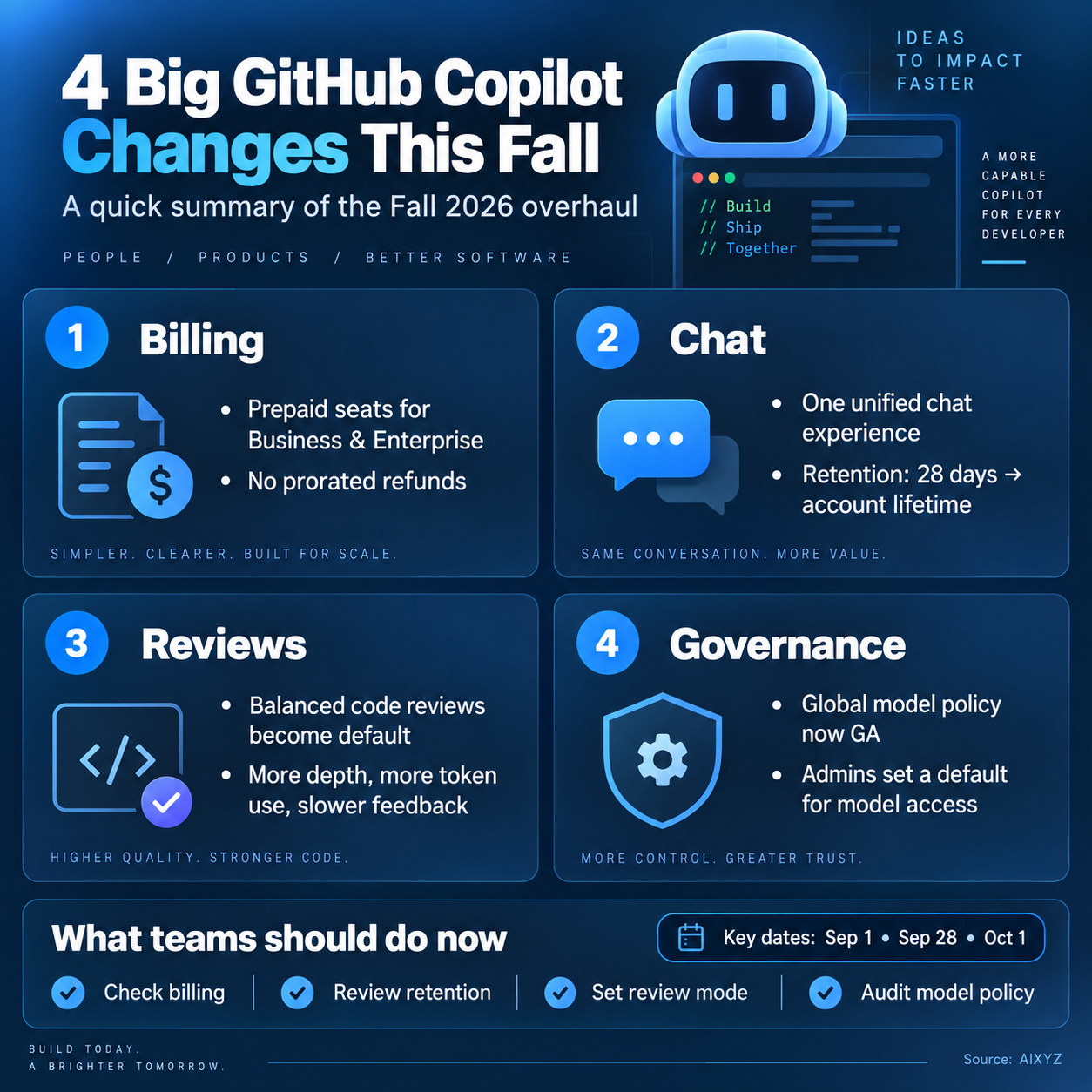
GitHub Copilot is heading into a very different fall than the one it left last year. On August 28, 2026, GitHub published a changelog post laying out a cluster of changes to how Copilot is billed, how its chat experience works, and what happens by default when it reviews your pull requests. None of these changes touch the AI models themselves — this is a governance and business-model overhaul, not a capability upgrade — but for the millions of developers and IT admins who rely on Copilot daily, it’s arguably more consequential than a new model release. Here’s what’s actually changing, when it lands, and why it matters.
Prepaid seats replace pay-as-you-go billing
The biggest shift is financial. Starting October 1, 2026, GitHub Copilot Business and Enterprise customers who pay by credit card or PayPal will need to pay for seats before access is granted, rather than being billed after the fact. New customers on these plans already need to prepay as of September 1. Per-seat pricing itself isn’t changing, but one convenience is going away: prorated refunds when a seat is removed partway through a billing cycle are being eliminated.
This lands on top of a bigger shift GitHub made back in June 2026, when it moved Copilot from a flat per-seat fee to a model that also meters token/request consumption for agentic features. As Mitch Ashley of The Futurum Group put it in comments to DevOps.com, charging upfront for seats while also metering usage is “how a vendor prices a product whose per-seat value is under pressure while its consumption climbs” — in plain terms, GitHub is tightening the business model around Copilot as usage patterns get more expensive to serve.
One unified Copilot Chat — with a much longer memory
Starting no earlier than September 28, 2026, GitHub is merging three separate surfaces — Copilot Chat on github.com, the GitHub Mobile app, and the cloud-based coding agent — into a single, unified chat experience. It will be turned on by default once it rolls out. You can opt out, but doing so removes Copilot chat access on both the web and mobile apps entirely, which makes “opting out” a fairly blunt instrument.
The change most worth flagging for IT and security teams isn’t the merged interface itself, it’s what happens to your conversation history once it’s merged: chat data retention is being extended from 28 days to the full lifetime of the account. That’s a meaningful shift for any organization with data-retention or compliance policies built around the old 28-day window, and it’s worth reviewing your org’s Copilot settings before the rollout rather than after.
Code review gets more thorough — and slower — by default
Also arriving on September 28, GitHub Copilot’s automated code review is switching its default effort level from “Lite” to “Balanced.” Balanced reviews dig deeper into a pull request, which generally means better catch rates on real issues, but it also means more token consumption per review and longer wait times before feedback lands. Organizations and individual repositories that prefer the faster, lighter review can keep it — but only if they explicitly select Lite as their default before the September 28 cutover. After that, Balanced becomes the out-of-the-box behavior for everyone who hasn’t opted out.
A global switch for which AI models your org can use
Rounding out the changes, GitHub’s “global model policy” reached general availability between August 26 and September 1, 2026, after being announced in July. Instead of admins configuring access model-by-model, the global policy sets a single default — enabled or disabled — that every new or previously unconfigured model inherits automatically. Admins can still override the default for specific models, and GitHub notes that open-weight models and models without a data retention agreement stay disabled regardless of what the global policy says. For large organizations managing a growing menu of underlying models (Copilot now routes across multiple providers), this turns a repetitive chore into a one-time policy decision.
Why it matters
Individually, none of these four changes is dramatic. Together, they read as GitHub treating Copilot less like a bundled IDE feature and more like enterprise software that needs its own governance, billing discipline, and default-behavior decisions — the same category of product management you’d expect from a CRM or an identity platform, not an autocomplete tool. If your team uses Copilot Business or Enterprise, the practical to-do list is short but time-sensitive: check your payment method ahead of the prepay requirement, decide whether Balanced or Lite code review fits your workflow, and — most importantly — revisit your chat data retention expectations before the September 28 rollout changes them for you.