An AI assistant drafts an email. AI agent approval matrix guides its use when the agent sends it, updates customer record, and schedules the follow-up.
That final step—from recommending an action to executing it—is where many organizations lose control. Moreover, vague instructions for the AI agent approval matrix exist, yet no one defines which human is responsible.
A useful approval model is more specific.
It identifies every action the agent can attempt.
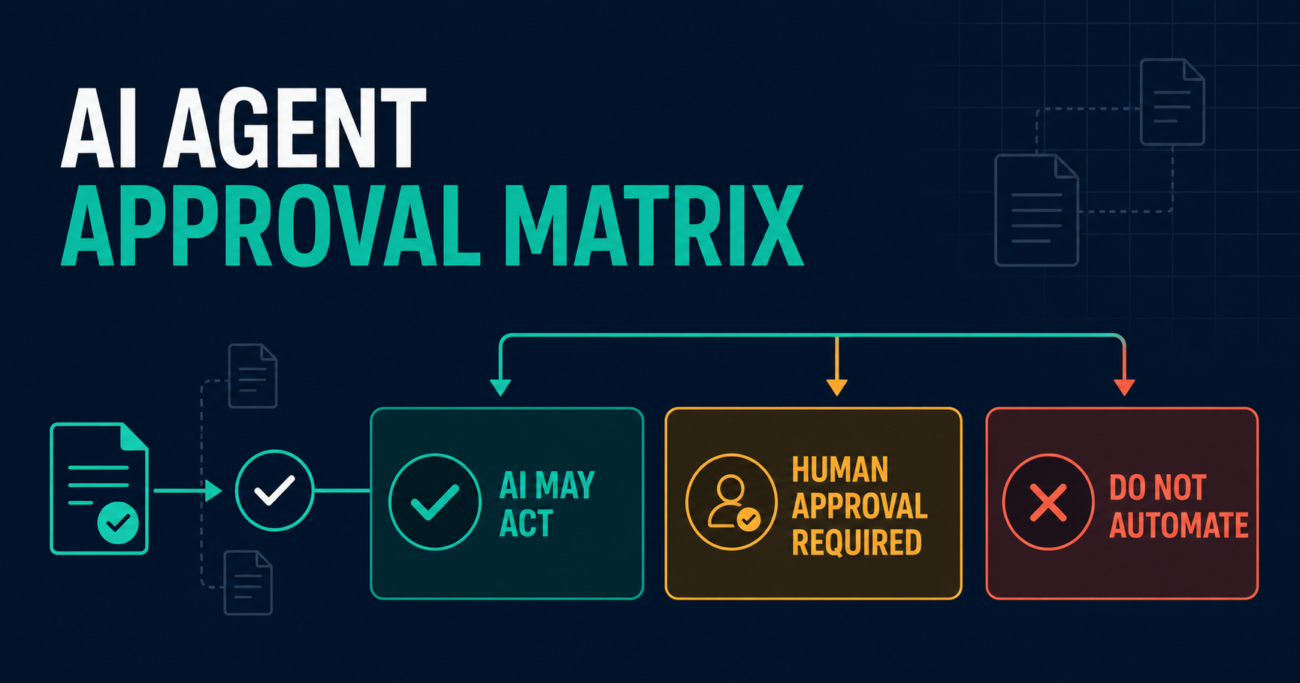
Consequently, it assigns each action to one of three lanes.
- AI may act within enforced limits.
- Human approval is required before execution.
- Do not automate because the impact or uncertainty exceeds the organization’s tolerance.
This guide provides an AI agent approval matrix.
Additionally, small businesses, project managers, and public-sector teams can adapt it to service, finance, HR, procurement, IT, and document workflows.
Important: This is practical operational guidance, not legal, security or compliance advice. Additionally, High-impact decisions and regulated processes require qualified legal, privacy, security, accessibility, records and subject-matter review.
Why “Human in the Loop” Is Not a Control by Itself
Human review sounds reassuring, but it fails when the workflow has not answered five questions:
- What exact event triggers approval?
- Who is qualified and authorized to approve?
- What evidence does the reviewer receive?
- Can the system execute before approval is recorded?
- What happens when the request is rejected, expires or cannot be reviewed?
An agent prompt that says “ask before sending” is not a dependable gate. The model may misunderstand the instruction, a workflow may bypass it, or a later configuration change may remove it. Consequential actions should be blocked by the surrounding application until an authorized reviewer approves them.
This distinction matters because autonomy increases potential impact. A drafting tool produces text for review. An agent with email, CRM, payment or production-system access can change the outside world—sometimes at machine speed.
Before designing approvals, complete AIXYZ’s AI Agent Security Checklist to define the agent’s scope, identity, permissions, data access, monitoring and shutdown controls.
What Authoritative Guidance Says
The following points are verified facts. The matrix and scoring method later in this article are AIXYZ’s practical interpretation, not an official standard.
The UK National Cyber Security Centre’s interim guidance, published on August 20, 2026, distinguishes three oversight models. Additionally, these are human-in-the-loop, where a person approves before action. Moreover, human-on-the-loop involves a person monitoring and the ability to intervene. Moreover, human-out-of-the-loop covers AI acting without human review. Additionally, it recommends human oversight and technically enforced controls when unintended activity could have significant consequences. Furthermore, the NCSC also recommends logging, monitoring and the ability to halt autonomous activity. Finally, read the NCSC guidance.
The OWASP AI Agent Security Cheat Sheet recommends least privilege, human-in-the-loop controls for high-risk actions, input validation, monitoring and data classification.
The NIST AI Risk Management Framework Playbook offers voluntary suggestions aligned to Govern, Map, Measure and Manage. NIST emphasizes that the Playbook is neither a mandatory checklist nor a compliance mechanism; organizations should select practices appropriate to their context.
AIXYZ analysis
The common principle is proportional oversight: autonomy should decrease as consequence, uncertainty, sensitivity and scale increase. “Human approval for everything” creates bottlenecks and rubber-stamping. “AI may act unless stopped” creates uncontrolled exposure. The right unit of governance is the individual action, not the agent as a whole.
The Three Approval Lanes
Lane 1: AI may act
Allow automatic execution only when the action is low-impact, bounded, reversible and observable. Examples may include:
- Applying an internal label to a duplicate test record
- Routing a non-sensitive document into a review queue
- Creating a draft in a private workspace
- Sending an internal reminder from an approved template
- Updating a low-risk status field under strict validation
“AI may act” does not mean unmonitored. Apply permissions, rate limits, validation, logs, alerts and a kill switch. The action should also stay within a defined volume and operating window.
Lane 2: Human approval required
Use a blocking approval gate when an action affects a customer, employee, citizen, payment, entitlement, public record, production system or external communication. Common examples include:
- Sending customer or public-facing messages
- Issuing refunds, credits or purchase orders
- Modifying official case or employee records
- Publishing content under the organization’s name
- Deleting or moving business records
- Changing user access or security settings
- Executing code or commands in production
The agent may prepare the action and supporting evidence, but conventional workflow logic should prevent execution until the correct person approves.
Lane 3: Do not automate
Some decisions should remain outside autonomous execution when the organization cannot reduce the impact or uncertainty to an acceptable level. Examples may include:
- Final employment termination decisions
- Final eligibility or benefits determinations without required due process
- Legal conclusions presented as professional advice
- Safety-critical decisions without an approved control framework
- Payments above delegated authority
- Destruction of records subject to a hold
- Actions the team cannot reliably detect, reverse or explain
AI may still support research, summarization or drafting where permitted. The final decision and action remain with qualified people following the established process.
Copyable AI Agent Approval Matrix
Use this starter matrix in a workshop with the business owner, process lead, security or IT representative and any required privacy, legal, records or compliance stakeholders.
| Agent action | Default lane | Minimum evidence shown to reviewer | Approver | Technical control |
|---|---|---|---|---|
| Search approved internal knowledge | AI may act | Sources accessed and citations | Monitoring owner | Read-only access and source allowlist |
| Create a private draft | AI may act | Input, source references and draft | End user reviews before use | Draft-only destination |
| Change a low-risk internal status | Conditional automation | Record ID, old value, new value and reason | Process owner sets rule | Schema validation, limit and audit log |
| Send an external email | Human approval required | Recipient, final text, sources and attachments | Authorized business user | Send endpoint blocked until approval |
| Modify a customer or citizen record | Human approval required | Record, proposed fields, evidence and impact | Record owner or supervisor | Field-level permission and approval token |
| Issue a refund or payment | Human approval required | Amount, account, policy basis and duplicate check | Delegated financial approver | Transaction limit and dual approval where required |
| Delete a record | Human approval required or prohibited | Record, retention status, dependencies and recovery option | Records or system owner | Soft delete, retention check and logged approval |
| Change permissions | Human approval required | Identity, current access, proposed access and justification | System owner | Privileged workflow; agent cannot self-approve |
| Make a final employment, legal, safety or eligibility decision | Do not automate by default | Follow the applicable formal process | Qualified accountable official | No execution tool exposed to agent |
The defaults are intentionally conservative. Customize them using your laws, contracts, delegated authorities, policies and risk tolerance.
Score Each Action Before Assigning a Lane
Rate each dimension from 0 to 2:
| Dimension | 0 | 1 | 2 |
|---|---|---|---|
| Consequence | Negligible | Correctable business impact | Material harm, rights, money or safety |
| Reversibility | Automatically reversible | Recoverable with effort | Irreversible or difficult to correct |
| Data sensitivity | Public or synthetic | Internal or limited confidential | Personal, regulated or highly confidential |
| External reach | Private workspace | Internal operational system | Customer, public or third party |
| Scale | One item | Limited batch | High volume or cascading action |
| Uncertainty | Deterministic and validated | Some judgment required | Ambiguous, novel or hard to verify |
Add the six scores:
- 0–3: Candidate for “AI may act,” if testing and technical controls pass.
- 4–7: Human approval required.
- 8–12: Do not automate by default; redesign or obtain specialized review.
These thresholds are planning heuristics, not a guarantee of safety. A single critical factor can override the total. For example, a low-volume action that changes a person’s legal rights should not become autonomous merely because the other scores are low.
Design an Approval That People Can Perform Properly
Show the evidence, not just the recommendation
An approval screen should present:
- The action the agent wants to take
- The affected person, record, system and destination
- Current and proposed values
- Sources or policy passages used
- Confidence or validation results, without implying certainty
- Detected exceptions and missing information
- The deadline and consequence of approval
- Approve, reject and return-for-correction options
A reviewer who sees only “Approve refund?” is being asked to trust the agent, not review its work.
Route to an authorized role
Do not send every request to a generic manager. Define approval by authority: finance approves payments, records staff approve destruction, system owners approve access and qualified program officials approve consequential service decisions.
For a small business, one person may hold several roles. Document that explicitly and appoint a backup. The agent, its developer and the requesting employee should not be allowed to approve beyond their delegated authority.
Define expiry and failure behavior
Approval requests should expire. If nobody responds, the safe default is usually no action, not automatic execution. Record the expiry, notify the owner and return the item to a queue.
Also prevent duplicate execution. An approval token should apply to one defined action, amount, record and version—not to a broad future set of actions.
Protect reviewers from rubber-stamping
Approval overload weakens oversight. Track approval volume, response time, rejection rate, overrides and corrections. If reviewers approve nearly everything in seconds, investigate whether they have enough evidence and time.
Use automatic execution only for actions that have earned it through representative testing. AIXYZ’s 30-Day AI Pilot Guide provides a structured way to measure accuracy, correction effort and operational value before scaling.
Practical Example: Accounts-Payable Agent
A company wants an agent to read invoices, match purchase orders and prepare payments.
The unsafe design gives it access to the mailbox, vendor master, accounting system and bank portal, then asks it to “process valid invoices.” A malicious invoice or simple mismatch could change the payee, duplicate a payment or expose confidential data.
A bounded design separates actions:
| Step | Lane | Control |
|---|---|---|
| Extract invoice fields | AI may act | Approved inbox, schema validation and logs |
| Match invoice to purchase order | AI may act | Read-only data and deterministic tolerance rules |
| Flag a mismatch | AI may act | Route to exception queue |
| Create payment proposal | AI may act in draft | No bank execution permission |
| Change vendor banking details | Human approval required | Independent verification outside the submitted invoice |
| Release payment | Human approval required | Delegated authority, amount limits and separation of duties |
| Pay an invoice above authority or with unresolved mismatch | Do not automate | Escalate and stop |
The design preserves useful automation without letting model output become payment authority.
Implementation Checklist
- List every action the agent can attempt—not only its stated goal.
- Score consequence, reversibility, data, reach, scale and uncertainty.
- Assign each action to AI may act, approval required or do not automate.
- Name the accountable owner and authorized approver for each gated action.
- Define the evidence the reviewer must receive.
- Enforce approval outside the model before the action endpoint executes.
- Set limits for value, volume, time, retries and destinations.
- Make expiry, rejection and failure default to no action.
- Log the proposal, reviewer, decision, execution and affected record.
- Test bypass, duplicate, stale approval and unavailable-approver scenarios.
- Monitor approval quality and signs of rubber-stamping.
- Reassess after changes to the model, prompt, tool, data, permissions or workflow.
If the organization does not yet know which AI tools employees use, start with the Shadow AI Audit. If organization-wide rules are missing, establish them with the AI Acceptable Use Policy Template.
Frequently Asked Questions
Does every AI agent action need human approval?
No. Requiring approval for every low-risk step can create delay and rubber-stamping. Automatic action may be reasonable when it is bounded, low-impact, reversible, validated, logged and tested. Consequential, sensitive or irreversible actions require stronger oversight.
Is a confirmation message inside the AI chat sufficient?
Usually not for consequential activity. Use a technically enforced workflow that blocks the action endpoint until an authorized identity approves the exact proposed action.
Can another AI model approve the first agent’s action?
A second model can help detect issues, but it is not automatically an independent or reliable control. The NCSC notes that judge models also have limitations and should be independently evaluated. Retain human oversight where consequences exceed tolerance.
Who is accountable when a human approves an AI recommendation?
Organizational policy should assign accountability to a named role. Approval should be meaningful: the reviewer needs authority, evidence, training and enough time. Adding a click does not transfer responsibility to the tool or vendor.
When can a human-approval step be removed?
Only after representative evidence shows that the action remains within tolerance and the organization has effective validation, permissions, monitoring, recovery and governance. Remove approval one action at a time—not for the entire agent—and preserve the ability to restore the gate.
Give Every Agent Action a Clear Boundary
“Human in the loop” is an intention. An approval matrix turns it into an operating control.
Inventory the actions, score their impact and assign each one to a clear lane. Let AI execute only where the consequence is limited and the controls are proven. Require authorized review before consequential actions. Keep decisions outside automation when rights, safety, law, money or irreversibility exceed your tolerance.
Start with one workflow and one page. The objective is not maximum autonomy. It is useful automation that your organization can explain, supervise, stop and defend.
Call to action: Copy the matrix into your next AI project workshop, assign owners and test every approval gate before production. For a broader deployment review, continue with the 15-point AI Agent Security Checklist.