Fine-tuning large language models has traditionally required significant GPU resources, complex infrastructure, and a fair amount of machine learning expertise.
An open-source project called Soup is trying to simplify that process.
https://github.com/MakazhanAlpamys/Soup
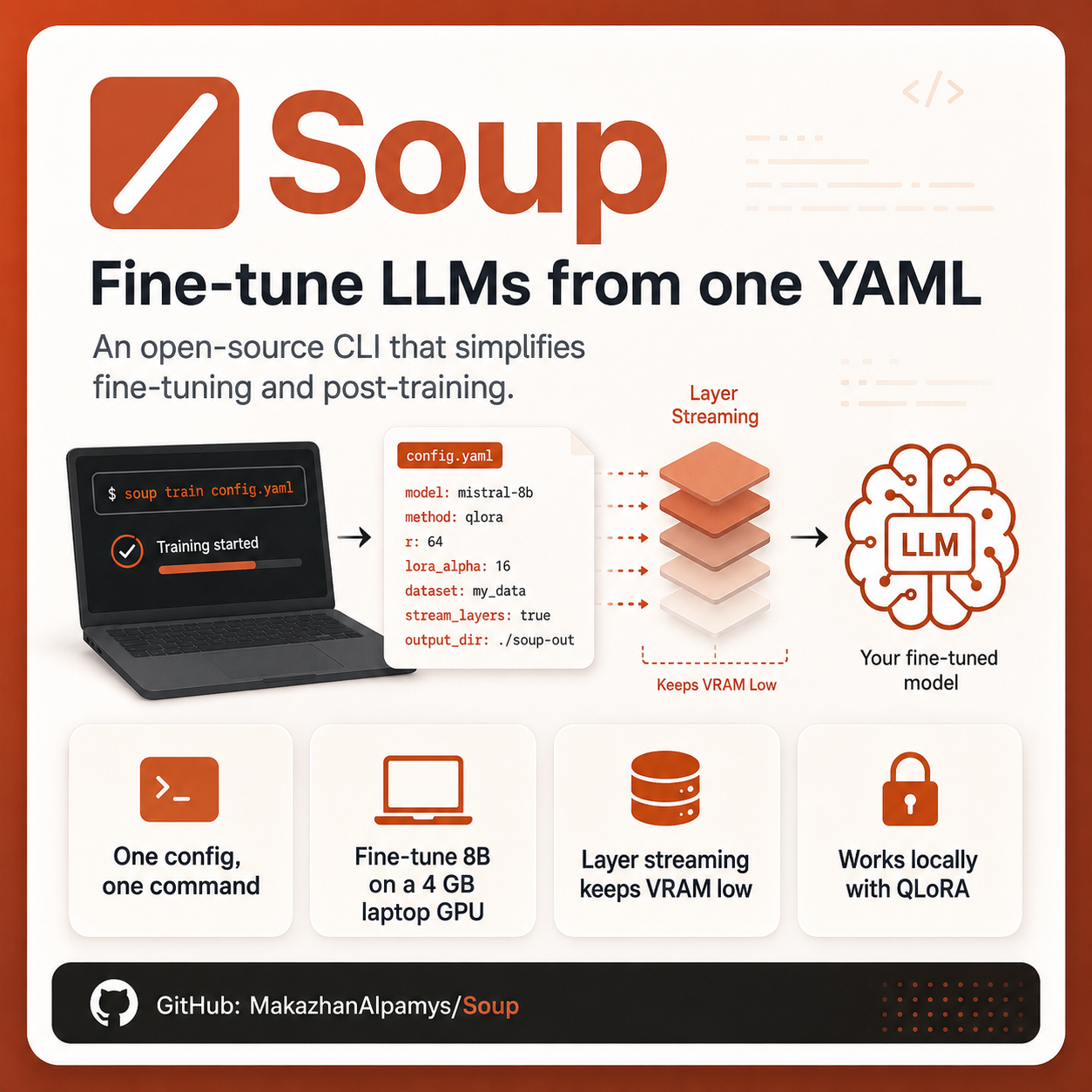
Soup is a command-line tool designed to make LLM fine-tuning and post-training easier by reducing much of the configuration and infrastructure complexity into a simple workflow built around a YAML configuration file and a few commands.
One of its most interesting features is layer streaming, which is designed to reduce GPU memory requirements enough that developers can experiment with relatively large models on modest local hardware.
According to the project documentation, Soup has demonstrated fine-tuning an 8B parameter model on a laptop GPU with only 4 GB of VRAM.
For developers, AI startups, researchers, and organizations experimenting with private or specialized AI models, this could make fine-tuning significantly more accessible.
What Is Soup?
Soup is an open-source CLI for fine-tuning and post-training large language models.
Its core idea is simple:
One configuration. One command. Less infrastructure work.
Instead of spending significant time configuring training environments, GPU settings, quantization parameters, and distributed infrastructure, developers can define their training setup inside a YAML file.
A basic workflow looks like this:
pip install "soup-cli[train]"

soup init --template chat

soup train
The project automatically handles several common training decisions such as GPU detection, batch sizing, and quantization.
That reduces some of the operational work typically required before a model training experiment can even begin.
Why LLM Fine-Tuning Is Still Difficult
Fine-tuning sounds straightforward in theory:
- Start with a pretrained model.
- Prepare your dataset.
- Train the model on domain-specific examples.
- Deploy the customized model.
In practice, the process can become complicated very quickly.
Teams often have to manage:
- GPU memory limitations
- CUDA environments
- PyTorch dependencies
- Quantization
- LoRA adapters
- Batch-size optimization
- Checkpoint management
- Training configuration
- Remote GPU infrastructure
- Distributed training environments
Soup attempts to abstract many of these concerns behind a developer-friendly command-line interface.
The project describes its goal as reducing the time engineers spend managing infrastructure so they can focus more on improving models and datasets.
The Most Interesting Feature: Layer Streaming
The feature that makes Soup particularly interesting is layer streaming.
Normally, when training or fine-tuning a model, a significant portion of the model weights must remain loaded in GPU memory.
For larger models, that can quickly exceed the VRAM available on consumer GPUs.
Soup takes a different approach.
Instead of keeping the entire frozen base model resident in GPU memory, its layer-streaming mechanism moves decoder layers to the GPU as they are required during training.
Conceptually, the workflow looks like this:
Model stored in RAM or disk → Layer moved to GPU → Adapter training performed → Next layer streamed
This dramatically reduces the amount of VRAM required at any one time.
Soup reports testing a configuration using:
- Llama 3.1 8B Instruct
- NF4 quantization
- LoRA
- Batch size 1
- Sequence length 512
- RTX 3050 Laptop GPU
- 4 GB VRAM
The project reports a peak GPU memory usage of approximately 3.32 GB for this configuration.
That is significant because 8B parameter models would normally require substantially more GPU memory.
What Is QLoRA?
Soup also supports QLoRA, a technique commonly used to make fine-tuning large language models more memory efficient.
Instead of updating every parameter inside the original model, LoRA introduces smaller trainable adapter matrices.
QLoRA goes further by quantizing the base model while training the adapters.
The result is significantly lower GPU memory usage compared with traditional full-model fine-tuning.
For organizations experimenting with domain-specific AI, this can make fine-tuning feasible without investing immediately in high-end GPU infrastructure.
One YAML File Instead of Complex Training Scripts
Another attractive part of Soup is its configuration approach.
Training settings can be defined in a YAML file.
For example:
training:
  stream_layers: true
  quantization: 4bit
  batch_size: 4
  stream_source: auto
  seed: 1234
The goal is to make experiments reproducible and easier to understand.
Instead of maintaining large training scripts filled with environment-specific logic, teams can keep training parameters inside configuration files.
That can be particularly useful when multiple developers or ML engineers are collaborating on experiments.
Local Fine-Tuning Without Cloud GPUs
Soup also supports local training.
This is important for several reasons.
Lower Experimentation Cost
Cloud GPUs can become expensive when teams are running frequent experiments.
Local training allows developers to prototype models before moving to larger cloud infrastructure.
Better Data Control
Some organizations work with sensitive internal information.
Running fine-tuning workloads locally may help reduce the need to move datasets into external cloud environments.
This can be particularly relevant for industries such as:
- Government
- Healthcare
- Financial services
- Legal services
- Research
- Enterprise knowledge management
Local training does not automatically solve security or compliance requirements, but it can give organizations additional architectural options.
Faster Developer Experimentation
Developers can iterate on datasets and training configurations directly from their workstation without provisioning remote GPU infrastructure.
Post-Training Support
Soup is not limited to supervised fine-tuning.
The project also supports several preference-training approaches, including:
- DPO
- ORPO
- SimPO
- KTO
Layer streaming has also been extended to some of these preference-training workflows.
This means developers can experiment with techniques that influence how models respond based on preferred and non-preferred outputs.
Preference optimization is increasingly important when building specialized assistants that need consistent behavior.
Potential Use Cases
Tools like Soup could be useful for several types of AI projects.
Domain-Specific Assistants
Organizations could fine-tune models around specialized terminology or workflows.
Examples include:
- Legal document analysis
- Government policy assistants
- Technical support models
- Healthcare terminology
- Financial document classification
Customer Support AI
Companies could train models using historical support conversations to improve how assistants understand common customer issues.
Structured Output Generation
Fine-tuning can help models consistently produce specific formats such as:
- JSON
- SQL
- API payloads
- Reports
- Forms
- Classification labels
Internal Enterprise AI
Organizations could customize smaller open models around internal workflows or domain-specific language.
AI Research and Experimentation
Students, researchers, and independent developers can experiment with fine-tuning techniques without immediately requiring enterprise-grade GPU infrastructure.
Why Small-Model Fine-Tuning Is Becoming More Important
The AI industry initially focused heavily on building increasingly large models.
However, a parallel trend is becoming equally important:
Smaller, specialized models.
Instead of using a massive general-purpose model for every task, organizations may increasingly use smaller models optimized for specific workflows.
For example:
A general-purpose model might handle thousands of different tasks.
A specialized 7B or 8B model might be optimized specifically for:
- Document classification
- Customer support
- Code generation
- Compliance analysis
- Knowledge extraction
Smaller models can potentially provide advantages in:
- Infrastructure cost
- Latency
- Data control
- Deployment flexibility
- Domain specialization
Tools like Soup could make experimenting with this model strategy easier.
Soup vs Traditional Fine-Tuning Workflows
Traditional LLM fine-tuning often involves several separate components.
You might need:
Training scripts
GPU infrastructure
Quantization configuration
LoRA configuration
Checkpoint management
Distributed training configuration
Soup attempts to simplify much of this into:
Dataset
↓
YAML configuration
↓
Soup CLI
↓
Fine-tuned model
That abstraction is potentially valuable for developers who want to focus on model behavior rather than infrastructure.
Is Soup Ready for Production?
Soup is an active open-source project, and some features, including layer streaming, are explicitly described as beta.
That means organizations should evaluate it carefully before using it in production environments.
Important areas to test include:
- Model quality
- Dataset handling
- Training reproducibility
- GPU compatibility
- Performance
- Security
- Dependency stability
- Model licensing
- Deployment architecture
The reported low-VRAM benchmarks are impressive, but organizations should validate those results against their own models, datasets, and hardware.
The Bigger Trend: AI Development Is Becoming More Accessible
Soup represents a broader change happening across the AI ecosystem.
Many capabilities that previously required specialized ML infrastructure are gradually becoming accessible through simpler developer tools.
We are seeing this across several areas:
Model inference
Tools such as Ollama and llama.cpp have made running models locally much easier.
AI application development
Frameworks are simplifying RAG, agents, tool calling, and orchestration.
Model fine-tuning
Tools like Soup are now attempting to simplify post-training workflows as well.
If this trend continues, fine-tuning could eventually become another normal part of the software development lifecycle rather than something limited primarily to specialized ML teams.
Final Thoughts
Soup is an interesting project because it targets one of the biggest barriers in LLM experimentation:
infrastructure complexity.
Its combination of YAML-based configuration, automated training setup, QLoRA support, local execution, and layer streaming could make model customization accessible to a much broader developer community.
The ability to experiment with an 8B model on a 4 GB laptop GPU is particularly noteworthy.
It does not eliminate the need to understand datasets, model behavior, evaluation, or responsible AI practices.
But it potentially removes a significant amount of infrastructure friction.
And that could matter a lot as organizations move from simply consuming foundation models toward building more specialized AI systems.
GitHub Project: MakazhanAlpamys/Soup