
Most organizations do not suffer from a shortage of AI ideas. They suffer from too many ideas with too little evidence.
Marketing wants faster content. Operations wants automated document processing. Sales wants better follow-up. Finance wants invoice review. Customer service wants an assistant. Leadership wants an “AI agent,” often before anyone has defined the workflow it should improve.
If every idea becomes a priority, none of them receives enough attention to succeed. The first AI project should not be the most futuristic idea or the one backed by the loudest executive. It should combine meaningful business value, manageable risk and enough organizational readiness to produce credible results.
This guide provides an AI use case prioritization matrix that small businesses, technical project managers and public-sector teams can use to compare opportunities consistently. It includes a weighted scorecard, stop conditions, a worked example and a meeting format for making a defensible decision.
Important: This is an custom planning method, not a legal opinion, procurement standard or official NIST assessment. Adjust the criteria to your organization, jurisdiction, contracts, policies and risk tolerance. Use specialized privacy, security, legal, accessibility and subject-matter review for consequential or regulated use cases.
Why AI Use Cases Need a Different Prioritization Method
A normal project portfolio may be ranked by revenue, cost, urgency and effort. AI introduces additional uncertainty:
- Output can vary even when the input appears similar.
- Performance in a demonstration may not match performance on real organizational data.
- A tool may expose sensitive information through prompts, connectors or logs.
- Human review can erase expected time savings if correction rates are high.
- The same technology can be low-risk in one workflow and high-risk in another.
- An agent that takes actions creates more operational risk than an assistant that only drafts.
That means “high value, low effort” is not enough. A useful AI prioritization method must examine the context of use, required data, human impact, workflow readiness, controls and ability to measure results.
What Current Evidence Says
The following facts are verified; the scorecard later in this article is practical interpretation of them.
The NIST AI Risk Management Framework treats risk as contextual and recommends prioritizing policies and resources according to the assessed risk level and potential impact of an AI system. NIST also states that the highest-risk systems deserve the most urgent and thorough risk-management effort. Its four core functions are Govern, Map, Measure and Manage.
OECD research published in November 2025 found that generative AI was used in 31% of more than 5,000 surveyed small and medium-sized enterprises across seven countries. Among SME users, 65% reported improved employee performance, while fewer reported scaling, competitive or revenue effects. The finding suggests that practical employee workflows may offer a more realistic starting point than ambitious transformation claims. See the OECD report on generative AI and the SME workforce.
On August 12, 2026, OpenAI reported that intensive enterprise users were moving from AI assistance toward execution through tools and repeatable workflows. Its evidence comes from OpenAI’s own customer base and should not be treated as a universal market measure. Still, the operational lesson is useful: deeper adoption requires context, permissions, review, governance and shared workflows—not simply more prompts. Read OpenAI’s enterprise adoption analysis.
For Canadian federal institutions, the Government of Canada’s Guide on the Use of Generative Artificial Intelligence emphasizes using AI only when it is relevant to program objectives and desired outcomes, while assessing risks involving data, privacy, security, bias, accountability and environmental impact. These requirements do not automatically apply to every private business, but they offer a useful public-sector reference.
AIXYZ analysis
These sources point to a disciplined sequence: define the outcome, understand the context, compare benefits with risks, confirm the organization can operate the workflow, and test performance against a human baseline. A project should earn its way into a pilot.
Start With a Specific Use-Case Statement
Do not score a category such as “AI for customer service.” It is too broad to evaluate.
Use this sentence:
For [user], use AI to [perform or assist with a defined task] using [approved information], so that [measurable outcome improves], with [human review or control].
Weak idea:
Use AI to improve customer service.
Scoreable use case:
For customer-service representatives, use AI to draft responses to routine, non-sensitive warranty questions from the approved knowledge base, so that median first-response time falls by 30%, with an employee approving every message before it is sent.
The stronger statement identifies the user, task, data, metric and control. If the team cannot write this sentence, it is not ready to rank the idea.
The AI Use Case Prioritization Matrix
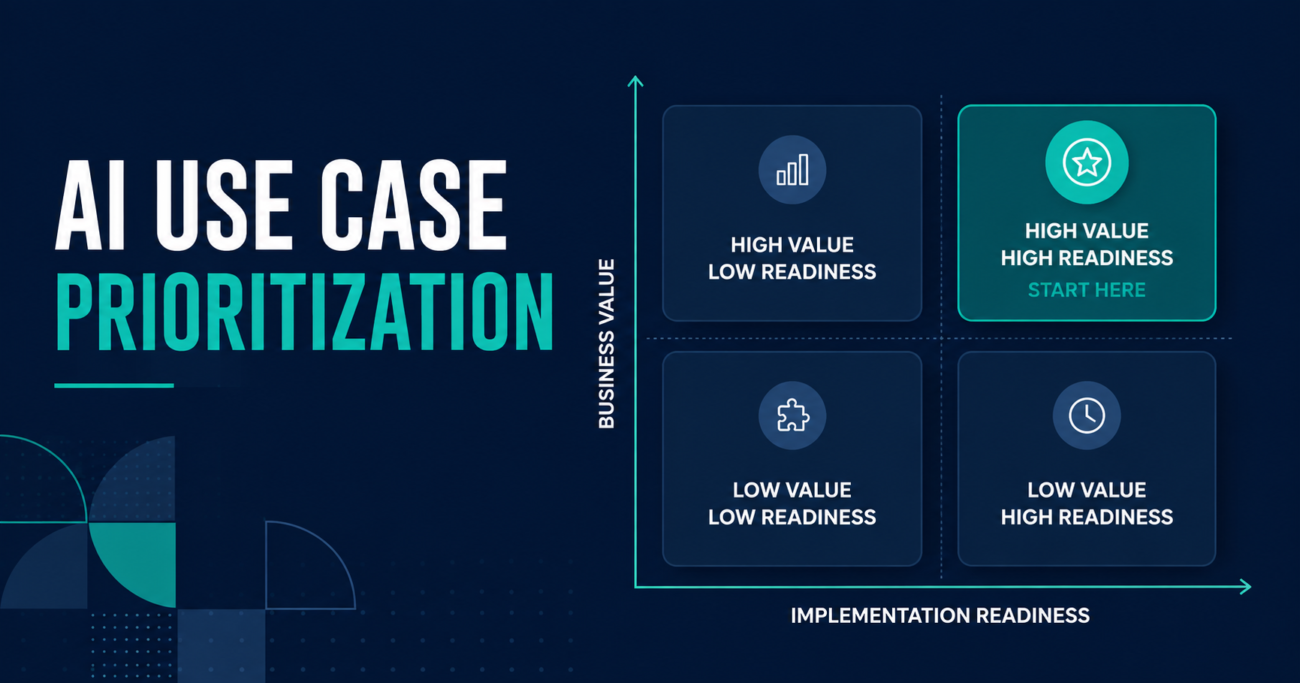
The matrix uses two visible axes and one decision filter:
- Business value: Is the problem important, frequent and measurable?
- Implementation readiness: Are the process, data, technology and people ready for a pilot?
- Risk and control: Is the likely impact acceptable, and can the main risks be managed?
Plot business value vertically and implementation readiness horizontally. Then apply risk as a gate before approving a pilot.
| Quadrant | Meaning | Recommended action |
|---|---|---|
| High value, high readiness | Strong pilot candidate | Validate risk controls, then pilot |
| High value, low readiness | Strategically useful but premature | Fix data, process, ownership or integration gaps |
| Low value, high readiness | Easy but potentially distracting | Use only as a learning exercise with tight limits |
| Low value, low readiness | Weak investment | Reject or archive |
The upper-right quadrant creates a shortlist, not an automatic approval. A high-impact use case can still be stopped by unresolved privacy, safety, legal or human-rights concerns.
The 100-Point AI Use Case Scorecard
Score each criterion from 1 to 5, then multiply by its weight. The maximum weighted score is 100.
| Criterion | Weight | What a score of 5 means |
|---|---|---|
| Strategic alignment | 10% | Directly supports an approved business or service objective |
| Problem frequency and scale | 10% | Affects a large, recurring workload or material service outcome |
| Measurable benefit | 15% | Baseline and target metrics are available |
| Process readiness | 10% | Current workflow, exceptions and ownership are documented |
| Data readiness | 10% | Required information is accurate, permitted and accessible |
| Technology and integration fit | 10% | The workflow can be tested without disproportionate complexity |
| User and owner readiness | 10% | A business owner and participating users are committed |
| Human oversight and recoverability | 10% | Errors can be detected, overridden and reversed |
| Risk manageability | 10% | Major privacy, security, legal and impact risks have feasible controls |
| Speed to evidence | 5% | A controlled test can produce useful evidence within 30–60 days |
How to calculate the score
For every criterion:
Weighted points = rating ÷ 5 × weight
If measurable benefit receives a rating of 4 and carries a 15% weight:
4 ÷ 5 × 15 = 12 points
Add all weighted points for the total.
| Total score | Portfolio decision |
|---|---|
| 80–100 | Shortlist for a controlled pilot, subject to risk gates |
| 65–79 | Promising; close the identified gaps before approval |
| 50–64 | Redesign, narrow or collect better evidence |
| Below 50 | Do not prioritize now |
These bands are management heuristics, not proof that a system is safe, compliant or valuable. A polished scoring exercise can create false confidence if ratings are unsupported. Require evidence beside every score.
Evidence to Require Behind the Scores
Do not let the workshop become a contest of opinions. Require a short evidence note beside every rating.
| Area | Useful evidence |
|---|---|
| Value | Strategic objective, monthly volume, delay, rework, service standard or complaint trend |
| Measurement | Current completion time, correction rate, cost, backlog or customer-experience baseline |
| Process | Workflow map, decisions, exceptions, handoffs, approvals and named owner |
| Data | Required sources, classification, quality, access rights, retention and permissions |
| Technology | Identity, connector scope, audit logs, integration needs, export and shutdown path |
| People | Participating users, reviewer capacity, training need and escalation authority |
| Risk | Privacy, security, bias, accessibility, intellectual-property and contractual review |
A task performed thousands of times may be more valuable than a dramatic annual task. Conversely, a time-saving claim is weak if the team has never measured current effort. When no baseline exists, measure the process before buying a tool.
“Human-in-the-loop” is also not evidence by itself. Name the reviewer, specify what they must check, confirm they have enough time and information, and define how they escalate or reverse an error.
Risk Gates That Override the Total Score
Pause the use case regardless of its score when:
- no accountable business owner will approve the outcome;
- the team cannot identify what data the system can access;
- personal, confidential or regulated information lacks an approved handling approach;
- the system will make or materially influence a high-impact decision without specialized review;
- affected people have no practical route to challenge or correct a consequential outcome;
- users cannot detect, override or recover from important errors;
- vendor retention, training or sharing terms remain unclear;
- the pilot would require production access broader than necessary; or
- applicable legal, policy, procurement or accessibility review has not occurred.
A risk gate does not always mean “never.” It means the organization has not earned permission to proceed yet.
Worked Example: Comparing Four AI Opportunities
Imagine a 120-person professional-services organization evaluating four ideas.
| Use case | Value / 35 | Readiness / 45 | Risk and evidence / 20 | Total | Decision |
|---|---|---|---|---|---|
| Draft routine client follow-up for employee approval | 27 | 38 | 16 | 81 | Pilot candidate |
| Summarize internal project status reports | 23 | 39 | 17 | 79 | Close measurement gap, then pilot |
| Rank job applicants automatically | 31 | 20 | 5 | 56 | Stop; high-impact and insufficient controls |
| Generate a monthly inspirational newsletter | 10 | 42 | 18 | 70 | Easy, but low strategic value |
The newsletter is easiest, but ease does not make it the best investment. Applicant ranking appears valuable, but its human impact and lack of controls make the total misleading. Drafting follow-up wins because it combines recurring value, workflow readiness, employee review and measurable results.
This is the discipline the matrix is designed to create.
Run a 60-Minute Prioritization Workshop
Before the meeting
Ask idea owners to submit a one-sentence use case, process volume, current baseline, required data, users affected, owner and known risks. Reject vague submissions until they are specific enough to score.
During the meeting
- 10 minutes: Confirm the decision criteria and risk gates.
- 15 minutes: Review and narrow each use-case statement.
- 20 minutes: Score individually before discussion to reduce anchoring.
- 10 minutes: Compare differences and demand evidence for extreme ratings.
- 5 minutes: Select one pilot candidate and one backup; assign gap-closing actions.
Use a facilitator who is not personally invested in one solution. Record assumptions and dissent, not only the final number.
After the meeting
The selected team should complete AI readiness assessment for the specific use case. Then compare products with the 15-point AI vendor evaluation checklist and test the winner through a 30-day AI pilot.
If current usage is unknown, first conduct a shadow AI audit. Establish basic employee rules with the AI acceptable use policy template.
Practical Pre-Pilot Checklist
- Use case is written in one specific sentence.
- Business owner is named.
- Current volume, time, cost or quality baseline is documented.
- Target outcome and pilot success criteria are measurable.
- Required data and connector access are mapped.
- Privacy, security, legal, contractual and accessibility needs are identified.
- Human review and exception handling are documented.
- Stop, rollback and incident routes exist.
- Representative test cases include difficult and failure scenarios.
- Users who perform the work helped design the pilot.
- Total cost includes licenses, integration, training, review and support.
- Final decision will be based on evidence, not demonstration quality.
Frequently Asked Questions
What is an AI use case prioritization matrix?
It is a portfolio tool for comparing AI opportunities using consistent criteria. The method in this guide evaluates business value and implementation readiness, then applies risk gates before a use case can enter a pilot.
What is the best first AI use case for a small business?
There is no universal winner. A good first use case is frequent, measurable, narrow, reversible and supported by an accountable owner. It should use information the organization is permitted to process and retain meaningful human review.
Should risk be subtracted from business value?
Not always. A single total can hide an unacceptable risk. Use risk-related scoring to compare manageable opportunities, but also maintain non-negotiable stop conditions that override the total.
How many AI use cases should a team pilot at once?
For a small organization, one primary pilot and one backup is usually more defensible than a broad portfolio. The real limit depends on available process owners, reviewers, security support and measurement capacity.
How often should the matrix be reviewed?
Review the portfolio at least quarterly and whenever the workflow, data, vendor, model, regulation or organizational objective materially changes. Readiness and risk are not permanent scores.
Can public-sector teams use this matrix?
Yes, as an initial portfolio method. Public-sector teams must also follow their jurisdiction’s procurement, privacy, security, records, accessibility, transparency and automated-decision requirements. Consequential service or eligibility decisions require much stronger assessment than low-risk internal drafting.
Choose One Use Case—and Make It Earn the Pilot
AI portfolios fail when ideas advance through excitement, vendor pressure or executive preference instead of evidence. A prioritization matrix creates a shared language for value, readiness and risk.
The goal is not to find the idea with the highest theoretical upside. It is to select a meaningful problem the organization can test responsibly, measure honestly and stop safely.
Use the scorecard with your team, select one candidate, document the evidence behind every rating, and apply the risk gates. Then move the winner into a controlled pilot—not directly into production.