Buying access to an AI tool takes minutes. Preparing a business to use it safely, consistently and profitably takes more work.
An organization can own excellent technology and still get poor results. Employees may not know which tasks to use it for. The necessary data may be scattered or sensitive. No one may own the outcome. A promising pilot can stall because the existing workflow, security controls or approval process was never considered.
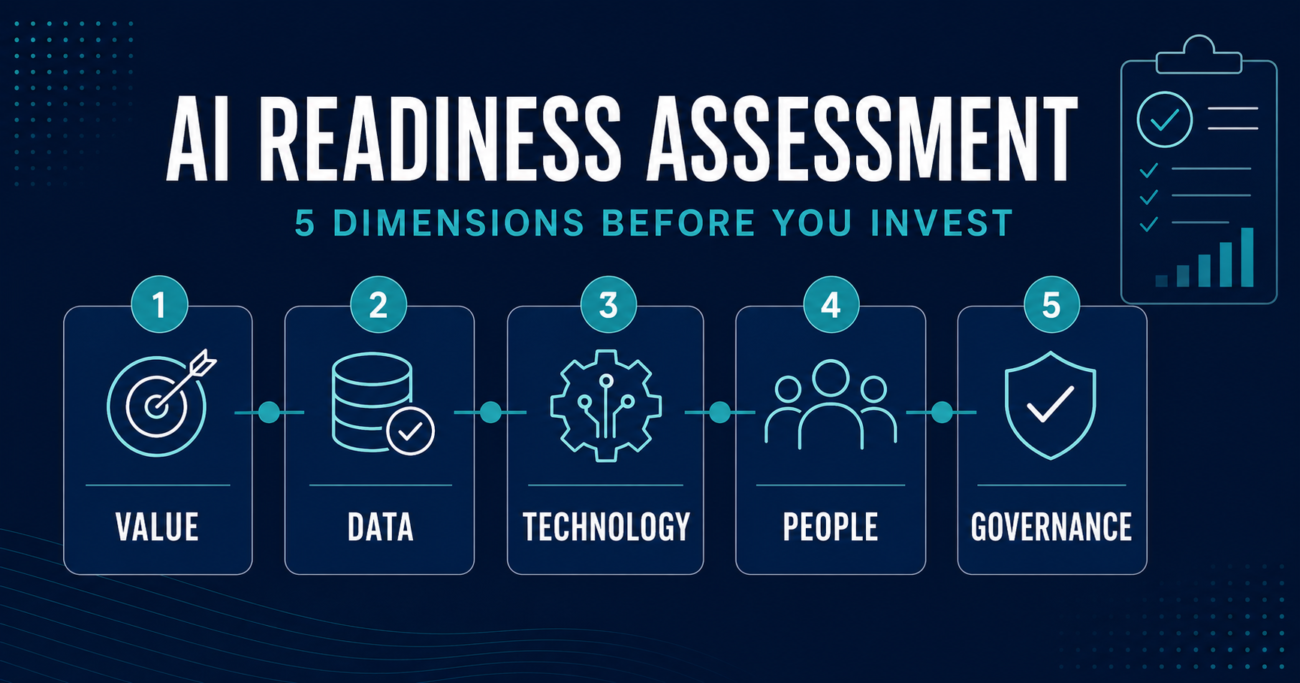
An AI readiness assessment helps expose those gaps before they become expensive. This guide gives small businesses, project managers and public-sector teams a practical 25-question scorecard across five dimensions:
- Business value
- Data
- Technology and security
- People and process
- Governance
The goal is to decide whether you are ready for a specific use case—and what must improve before you pilot or scale it.
Important: This assessment is an AIXYZ planning tool, not a certification, legal opinion or official NIST checklist. Requirements depend on the use case, jurisdiction, industry, contracts and impact on people. High-impact or regulated projects need specialized privacy, security, legal, accessibility and subject-matter review.
What AI Readiness Actually Means
AI readiness is an organization’s ability to turn a defined business need into a controlled, measurable AI-enabled workflow.
Readiness is contextual. A business might be ready to draft public social-media posts but not to summarize customer files, connect an agent to financial systems or support employment decisions.
A useful assessment therefore asks three questions:
- Can we create measurable value?
- Can we manage the likely risks?
- Can our people operate and improve the workflow?
The NIST AI Risk Management Framework supports this context-based approach through four functions: Govern, Map, Measure and Manage. NIST describes the framework as voluntary. Its accompanying AI RMF Playbook provides suggested actions rather than a universal checklist that every organization must complete in full.
For Canadian organizations, the Office of the Privacy Commissioner of Canada emphasizes responsible, privacy-preserving adoption when AI involves personal information. Public-sector teams should also consult the Government of Canada’s current responsible-use AI guidance and the policies that apply to their institution.
The scorecard below translates these broad principles into a small-organization planning exercise. It does not establish conformity with any framework.
How to Use the AI Readiness Scorecard
Choose one use case before answering the questions. “Use AI in customer service” is too broad. “Draft first responses to common, non-sensitive email inquiries for staff approval” is specific enough.
Bring together the process owner, an employee who performs the work, an IT or security representative and someone accountable for privacy or risk. In a very small business, one person may cover several roles, but the perspectives still matter.
Score each statement from 1 to 5:
| Score | Meaning |
|---|---|
| 1 | Not in place or unknown |
| 2 | Informal, incomplete or dependent on one person |
| 3 | Partly documented and workable for a limited pilot |
| 4 | Documented, assigned and generally repeatable |
| 5 | Measured, tested and routinely improved |
A low score is useful when it reveals the next investment to make.
Dimension 1: Business Value
Start with the work, not the model. A clear problem makes product selection, testing and ROI measurement far easier.
Score these five statements
- We can describe the use case in one sentence, including the user, task and desired result.
- The problem occurs often enough—or has enough impact—to justify changing the process.
- We have a baseline for time, cost, error, delay, volume or customer experience.
- A named business owner is accountable for the result.
- We have defined success and failure criteria for a limited pilot.
Evidence to collect: a process map, monthly task volume, sample outputs, current completion time, correction rate, complaints or service-level measures.
Suppose a consulting firm wants AI to summarize meeting notes. “Save time” is not yet measurable. A stronger baseline records the current drafting time, correction rate and approval requirement.
If you cannot establish the baseline, measure the current process for two weeks before buying anything.
Dimension 2: Data Readiness
AI systems depend on the information entered, retrieved or generated. Data readiness is not only about having a large database. It means knowing what information the use case needs, where it comes from, how reliable it is and whether you are permitted to use it.
Score these five statements
- We know which data, documents or knowledge sources the use case requires.
- The information is sufficiently accurate, current and consistently formatted for the task.
- We have classified the information as public, internal, confidential, personal or regulated.
- We understand our authority, contractual rights and restrictions for using the information.
- We can correct, remove, update or restrict access to source information when needed.
Evidence to collect: a data inventory, sample records, retention rules, contractual terms, privacy notices, permission groups and data-quality checks.
Do not limit this review to text typed into a prompt. A connector to cloud storage, email or a CRM may expose far more information than an employee intentionally submits. Review what the integration can retrieve, what the vendor retains and which users inherit access.
If personal information is involved, seek appropriate privacy advice early. Privacy cannot be added effectively after a workflow has already been designed around unnecessary data.
Dimension 3: Technology and Security
The best model is not automatically the best business system. The surrounding controls determine whether employees can use it reliably and administrators can manage it.
Score these five statements
- The proposed tool fits our existing devices, identity system and workflow.
- We can enforce appropriate authentication, access roles and administrator controls.
- We understand where data is processed, how long it is retained and whether it is used to train models.
- We can log or review important activity, configurations and connected data sources.
- We have technical support, backup procedures and a path to export data or stop using the service.
Evidence to collect: architecture diagram, vendor terms, data-flow map, access matrix, security documentation, audit-log examples and exit plan.
A manual pilot using de-identified documents may require modest integration. An autonomous agent that can send emails, update records or initiate transactions requires stronger identity, permission, logging and recovery controls. Match the control level to the possible impact.
Before choosing a product, use AIXYZ’s 15-point AI vendor evaluation checklist to compare business fit, privacy, security, reliability and total cost.
Dimension 4: People and Process
AI adoption changes work. Someone must prepare inputs, review outputs, handle exceptions and decide when the system should not be used. If those responsibilities are invisible, the technology may simply move effort from one part of the process to another.
Score these five statements
- The employees who perform the work helped define the use case and pilot.
- Users understand the tool’s limitations and can recognize common failure modes.
- Human review, approval and escalation points are documented.
- The workflow allows employees to report errors, near-misses and improvement ideas without penalty.
- Training, process documentation and ongoing support have named owners.
Evidence to collect: workflow diagram, role descriptions, training plan, review checklist, escalation route and feedback log.
Training should be task-specific. A generic presentation about prompting will not prepare an accounts-payable team to validate extracted invoice fields or a communications team to check sources, tone and copyright concerns.
The OECD’s 2026 AI and skills report notes that adoption barriers are not limited to advanced technical skills. Digital, data-interpretation, managerial and human skills also matter. For most small organizations, building informed users and capable process owners is more important than turning every employee into an AI engineer.
Dimension 5: Governance
Governance answers who can approve AI, what rules apply and what happens when something goes wrong. It should be proportional. A small business does not need a large committee for a low-risk writing assistant, but it still needs ownership and boundaries.
Score these five statements
- We have rules defining approved tools, data restrictions and prohibited uses.
- We maintain an inventory of AI tools and use cases, including employee-led experiments.
- A named person can approve, pause or retire the use case.
- We have a process for vendor review, incident response and periodic reassessment.
- We have identified applicable laws, policies, contracts and stakeholder impacts.
Evidence to collect: acceptable-use policy, AI inventory, approval record, risk assessment, vendor review, incident process and review schedule.
If these foundations are missing, start with the AIXYZ AI acceptable use policy template and shadow AI audit. Together, they establish basic rules and reveal the tools already in use.
Interpret Your Total Score
Add the 25 scores. The maximum is 125.
| Total score | Readiness level | Recommended next move |
|---|---|---|
| 25–49 | Foundation required | Do not purchase or connect sensitive systems yet. Define the use case, assign ownership and fix critical data or governance gaps. |
| 50–74 | Early readiness | Run discovery work with public or de-identified information. Close red flags before a formal pilot. |
| 75–99 | Pilot-ready | Conduct a controlled, time-limited pilot with baseline measures, human review and documented controls. |
| 100–125 | Ready to scale carefully | Confirm the score with evidence, test failure scenarios and establish monitoring before wider deployment. |
These bands are planning heuristics, not a universal maturity standard. Examine each dimension as well as the total. A score of 100 should not hide a data score of 8 when the use case processes sensitive customer records.
Use readiness gates for critical issues
Pause the project regardless of the total score if:
- no business owner will accept accountability;
- the team cannot explain what data the system can access;
- personal, confidential or regulated information lacks an approved handling approach;
- the tool will make or materially influence high-impact decisions without specialized review;
- no human can detect, override or escalate consequential errors;
- vendor terms, retention or model-training practices remain unclear; or
- there is no safe way to stop the workflow and recover.
These are not permanent rejections. They are conditions to resolve before proceeding.
Example: Assessing an AI Email Assistant
A property-management company wants an assistant to draft replies to routine tenant questions. It scores the use case as follows:
| Dimension | Score | Finding |
|---|---|---|
| Business value | 21/25 | High message volume and response-time baseline are documented. |
| Data | 12/25 | Emails may contain personal and financial information; classification is inconsistent. |
| Technology and security | 16/25 | Enterprise controls are available, but connector permissions need testing. |
| People and process | 18/25 | Staff will approve every message, but escalation examples need documentation. |
| Governance | 14/25 | An AI policy exists, but there is no incident route or review schedule. |
| Total | 81/125 | Pilot-ready only after the data and governance gaps are addressed. |
The total suggests a pilot, but it should not begin immediately. The team first limits the pilot to a non-sensitive inquiry category, configures access, documents prohibited data, creates an escalation route and tests whether staff can identify unsafe drafts.
That is the value of the assessment: it changes “Are we ready?” into a short list of concrete actions.
Turn the Assessment Into a 30-Day Action Plan
Week 1: Define and measure
- Select one narrow use case.
- Name the business owner and participating users.
- Map the current workflow.
- Record baseline time, volume, quality and cost.
Week 2: Close critical gaps
- Classify the required information.
- Review permissions, privacy and vendor terms.
- Define human approval and escalation.
- Resolve every readiness gate that applies.
Week 3: Prepare the pilot
- Select representative test tasks.
- Configure the least access required.
- Train users on the workflow and limitations.
- Define success, failure and stop criteria.
Week 4: Make an evidence-based decision
- Run controlled tests using realistic work.
- Record errors, correction time and exceptions—not only successful examples.
- Re-score the five readiness dimensions.
- Approve, revise, pause or reject the use case.
When the foundation is sound, follow the complete AIXYZ guide to run a 30-day AI pilot before you scale.
Frequently Asked Questions
Does a small business need perfect data before using AI?
No. Data needs to be fit for the specific task. A tool that rewrites public marketing copy has different requirements from a system retrieving customer records. Identify the minimum information needed, test its quality and restrict anything unnecessary.
What is a good AI readiness score?
In this assessment, 75 or higher suggests that a controlled pilot may be reasonable. The total is not an approval by itself. Low scores in privacy, security, human oversight or ownership can stop a project regardless of the total.
Who should complete the assessment?
Include the business owner, employees who perform the work, IT or security and the person responsible for privacy or risk. For public-sector or regulated uses, add legal, accessibility, equity, procurement and subject-matter expertise as appropriate.
Should we assess the organization or the AI tool?
Assess both, but separately. Readiness examines your use case, data, people, process and governance. Vendor evaluation examines a product’s controls, terms, reliability, integration and cost. A strong vendor cannot compensate for an undefined workflow or missing accountability.
How often should we repeat the assessment?
Reassess before a pilot, before expanding access or data, after a major product or model change and when an incident or persistent performance problem occurs. Review active use cases periodically because vendors, configurations, workflows and risks change.
Is this assessment enough for high-impact automated decisions?
No. Decisions affecting employment, credit, health, benefits, legal rights or access to public services may trigger additional legal, policy, impact-assessment and procedural requirements. Obtain qualified advice and apply the rules relevant to your organization and jurisdiction.
The Best First AI Investment May Be Preparation
AI readiness is not a race to reach the highest maturity score. It is the discipline to choose a valuable use case, expose weaknesses early and invest in the smallest set of changes needed for a responsible test.
Complete the scorecard with evidence, focus on the lowest dimension and resolve critical gates before purchasing or connecting a tool. Then run a controlled pilot that measures real work.
Call to action: Use this assessment in your next leadership or project meeting. Score one proposed AI use case, assign an owner to every gap and set a date for a go/no-go pilot decision. For the next step, download or copy the AIXYZ vendor checklist and 30-day pilot plan linked above.